Powered trailers offer a painless path to electrifying heavy-duty transport.
Trucking firms are caught in a bit of a bind. They need to electrify before their competitors do, or risk being undercut on the all-important metric of cost per mile—however, electric trucks come with high upfront costs, and when it comes to long-haul Class 8 trucks, range, weight and charging infrastructure remain challenges.
What if you could eliminate those objections by thinking outside the box—or by electrifying the box itself? That is, why not electrify the trailer instead of the tractor? If you could add batteries and a motor to a trailer, you could realize substantial fuel savings while continuing to use your existing tractors.
A powered trailer, which incorporates a battery pack and an electric motor, offers several advantages as an alternative to (or in addition to) an all-electric truck. It’s a drop-in replacement for existing trailers that can be used with any tractor—diesel or electric. There’s little or no learning curve for drivers. Range is not an issue—if the trailer’s battery runs out of juice, you simply keep rolling. Charging is much less of an issue—a trailer can be charged while loading or unloading, while the tractor drives off to pick up another load. And as we shall see, a powered trailer can include intelligent features that help to make the driving experience easier and safer.
At the moment, there are two companies selling powered trailers—US-based Range Energy and Germany-based Trailer Dynamics (both companies are currently taking orders, but deliveries have not yet begun). Both companies have designed their trailers to pull their own weight, so to speak. Range Energy says its system provides “just enough propulsion to make the trailer feel weightless to whatever is towing it.” As Trailer Dynamics puts it, “The eTrailer is designed to cancel out all its driving resistance on routes of 500-800 km.”
A third company, Revoy, offers a variation on the concept—a powered dolly that fits between tractor and trailer, in effect converting a diesel tractor into a hybrid. In addition to delivering fuel savings, all three of these companies’ products are designed to interact with the tractor to improve handling and safety.
There are also companies developing electrified Transport Refrigeration Units (TRUs), which today are powered by built-in diesel generators.
Range Energy
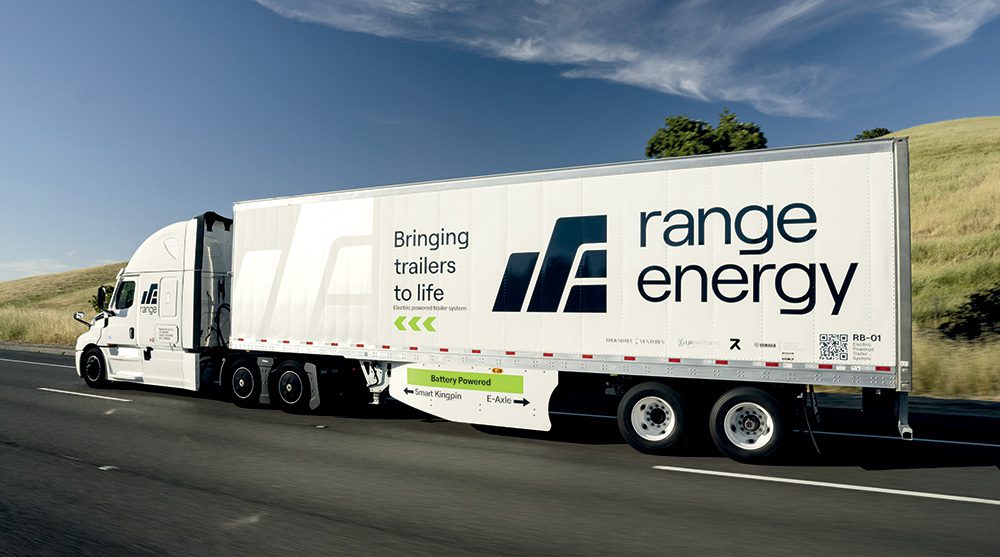
California-based Range Energy, founded in 2021, has developed an eTrailer system that can be installed on any dry van or refrigerated semi-trailer. “We think of it as a less burdensome version of electrification,” Chief Product Officer Jason Chua explained to Charged. “You can hook up your accessories, like a TRU, a liftgate or whatever, and then you’re off and running.”
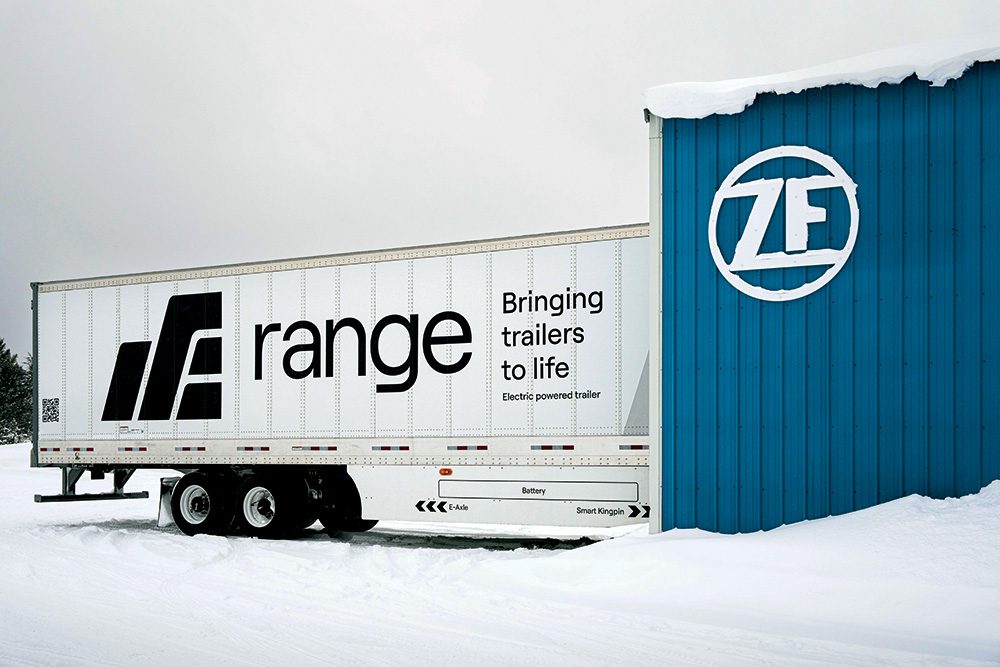
The system, which adds about 5,500 pounds of weight to the trailer, is composed of three major components. The first is an electrified axle, currently provided by Tier 1 supplier ZF. “We are able to use other OEM eAxles, but ZF is what we’re launching with,” Chua told us. “The second component is a high-voltage battery pack—either 200 or 300 kilowatt-hours, but I think early units are probably going to ship with a larger battery pack. The third component is our safety controls system and sensor suite. It’s the world’s first trailer traction control system, so we can do stability work and braking.”
Range is starting out by selling directly to carriers. “Shippers are sometimes involved, and trailer OEMs can be channel partners—we’re collaborating with some of them for testing. But this is a new product category, so we want to get out there and work with fleets, educate them on what we’re doing, get a better understanding of how they run their business, and make sure that we have a really good fit.”
Over the past few months, Range has been taking its beta units on the road with customers for pilots, and has demonstrated a 60-to-70% increase in MPG while also powering a TRU in 100% electric operation.
Range Energy has demonstrated a 60-to-70% increase in MPG while also powering a refrigeration unit in 100% electric operation.
There are a lot of trailers out there, with many different specific configurations of things like rail pitch, liftgate specs and door positioning—that’s why Range opted to go with a retrofittable system rather than selling complete trailers. “That allows us to get this technology deployed faster than the typical replacement age for trailers, which could help us scale quite quickly,” Chua told us.
“Our system is designed to be installed in just a few hours with one or two people using a forklift, so this is something you could do at a dealer location. The battery bolts on to the bottom of the trailer. The eAxle you just swap out with the forward axle on the trailer bogie. You connect the two, and the sensors are already integrated into the system, so that’s about it.”
Keep on trucking
In addition to saving money and reducing emissions, Range Energy’s trailer can adjust torque and braking in real time to improve safety and the driving experience. We were surprised to learn that this requires no data connection between the tractor and the trailer.
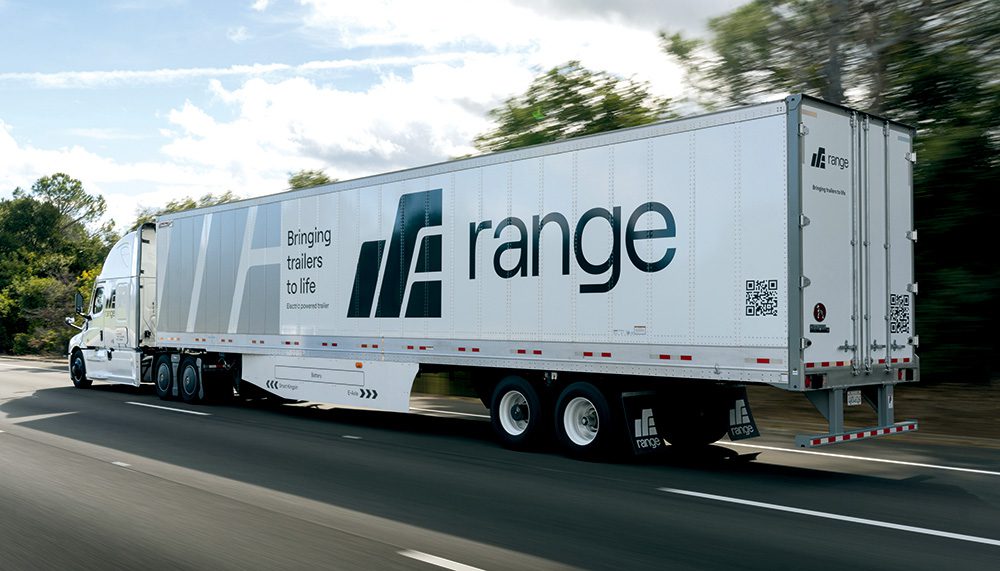
A standard semi rig has a connector between tractor and trailer that operates brake lights and the ABS system (it uses the SAE J560 standard). “It’s an electrical connector, it’s not really a data connector,” Chua explained. “You might see other similar systems connected with a CAN bus, but Range’s system doesn’t require that. It’s just the air lines, the brake lights (the J560 connector), and of course the kingpin, and those are the only points of connection between the tractor and the trailer with our system.
The only points of connections between the tractor and Range’s trailer system are the air lines, the brake lights and the kingpin.
“We are able to sense when the driver’s trying to brake from the tractor, and we react quite quickly to those signals. One of the things that we wanted to avoid is new standards, new connectors, training the driver to plug one more thing in. Truckers have a complicated enough job as it is, and our goal is to make this as simple as possible.”
Range’s system can provide extra torque when needed, for example to provide additional acceleration to climb a hill, or to make shifting gears smoother. The system also intelligently manages regenerative braking to improve traction and stopping distance.
Mr. Chua showed us a video of winter testing the company did in northern Michigan to validate the trailer’s traction control. “We did some stopping distance tests, we did some evasive maneuvers, and in pretty much all cases, we saw performance improvements with our system. It has a very fast reaction time and we have a good understanding of the environment with respect to things like how slick a surface is and what the cornering force looks like.”
How does all this work with no data connection? “That’s our secret sauce,” Chua told us. “We have a distributed network of sensors that allows us to understand what’s going on with the relative motion of the trailer and the tractor. Using that information, we can send commands to the powertrain to provide drive torque or regen-braking torque as appropriate.”
Range Energy President and CTO Ali Javidan identified another benefit of powered trailers in an interview with Clean Trucking: “Because the tractor sees a lot less load, we have customers saying, now we can buy the smaller block engine. Our transmissions are lasting five times longer because we’re not wearing through clutches in between shifts. Our brake duty cycle is 3 to 5 times longer because we’re using regen instead of friction brakes.”
Yet another of the advantages of electrifying the trailer instead of the tractor is that it makes charging simpler. “Tractors tend to be in motion a lot more often,” Jason Chua told Charged. “Trailers sit around for 8 to 12 hours a day, because it takes some time to load and unload the trailer.”
Trailers also don’t require the heroic levels of charging power that heavy-duty trucks do. “Our 300 kWh battery pack is large, but it’s not massive. Our system doesn’t require the sort of heavy charging infrastructure like the Megawatt Charging System [MCS] that you’d need for charging electric tractors.”
Riding with the King
Range recently announced a partnership with Thermo King, a Minnesota-based manufacturer of transport temperature control systems. The company already has a hybrid TRU, which Range is integrating with its system.
“Thermo King’s TRUs can run in either diesel or electric mode,” Chua told us. “When you’re at the dock plugged into shore power, they run on electric. We enable that electric operation even while the trailer’s in motion.”
Thermo King has an extensive dealer network, including shops where equipment can be installed. “They’re rolling out high-voltage training across their dealer network. They really are leaning forward on electrification, and we can benefit from that. Rather than stand up hundreds of dealer locations across the country, we can leverage a great partner that already has them, and enable installation, distribution, service and after-sales with people that these fleets already know.”
Chua sees several reasons to target the refrigerated transport (aka cold chain) market. “I think some of the first adopters we’re going to see are food service distribution fleets. They have a great use case for eTrailers in terms of route length and stops. We can save a lot of fuel from the reefer unit, and these are folks that tend to be early adopters of new technology.”
They also have what’s called shore power. The plug at the dock that you plug your refrigeration unit into, we can use that same circuit to charge our system. We can charge with DC or AC.
Targeting refrigerated fleets also presents advantages in respect to charging. “Lots of these fleets have refrigerated warehouses, which already have a decent amount of power available to them. They also have what’s called shore power. The plug at the dock that you plug your refrigeration unit into, we can use that same circuit to charge our system. We can charge with DC or AC.”
When can I buy, and for how much?
Range is currently conducting extended pilots with “some of the largest fleets in the country.” Chua told us that the company is ramping up its manufacturing process, and plans to begin deliveries “some time in 2026.”
So, how much does the system cost? Chua told me in a roundabout way. “We’re looking at a four-to-five-year payback period today. As we scale, our costs will decline and we’re going to get closer to a three-year payback. But right now we’re seeing about a $25,000-per-year net savings per trailer, and you can do the math.”
We can, and it works out to $100,000 to $125,000 for Range Energy’s system (which can be added to a new or existing trailer). Chua told us that, for a new refrigerated trailer, a company would typically pay somewhere between $150,000 and $200,000, depending on the refrigeration unit, liftgates and other accessories required.
At the moment, Range has only one major competitor, and it’s on the other side of the Atlantic. “Trailer Dynamics is covering Europe, we’re covering North America,” says Chua. “Will we look at Europe in the future? Will they look at North America in the future? I think that’s all TBD, right?
Keeping it cool without diesel
Another way of saving energy in transport doesn’t involve propulsion, but rather cooling. Today, keeping food (or medical supplies or other products) chilled or frozen during delivery means running diesel engines on the back of trucks—burning fuel even when vehicles are stationary. In addition to Thermo King, several other companies are testing electric or TRUs.
UK supermarket chain Tesco is testing electric refrigeration technology from British engineering company Sunswap, which incorporates batteries and roof-mounted solar panels. Italy-based SolarEdge e-Mobility is testing a solar-powered e-reefer with an energy recuperation axle. Other electrified TRUs in testing include Schmitz Cargobull’s S.KOe COOL and ConMet’s Nmotion TR series, both of which use an electrified axle to power the TRU.
Trailer Dynamics
Germany-based Trailer Dynamics was founded in 2018. Like Range, it has developed powered trailers that save on fuel and emissions and also offer new safety and driver assistance features. “We have consistently driven forward the eTrailer concept, achieving significant breakthroughs, particularly in the sophisticated control systems essential for seamless interaction between the tractor unit and trailer,” CEO Abdullah Jaber told Charged. “These innovations enable the eTrailer to offer efficient electric drive support, advanced recuperation capabilities and intelligent load management—features which were previously unavailable in trailer technology.”
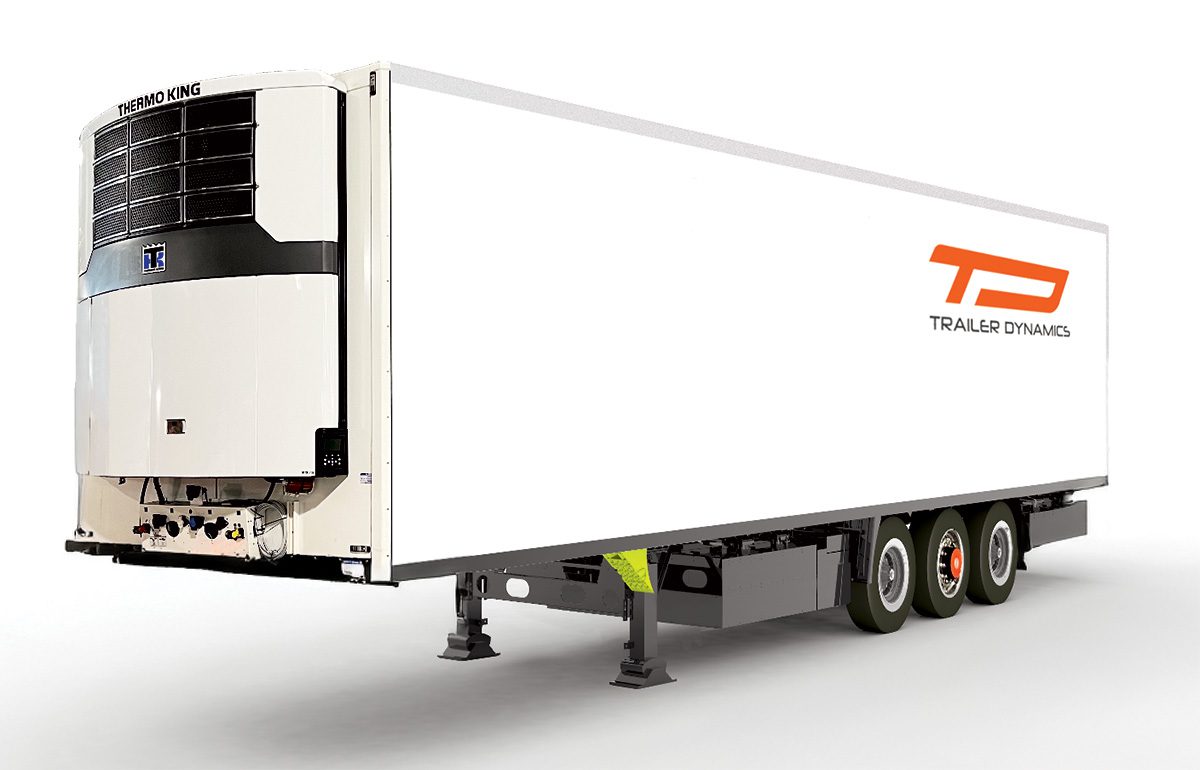
A complete eTrailer
Trailer Dynamics is taking a different approach from Range Energy—instead of a retrofit kit, TD (with trailer maker KRONE as manufacturing partner) offers “a new, fully integrated semi-trailer with battery, eAxle, power electronics, controls and telematics engineered as one system and validated at OEM trailer level. That lets us optimize weight distribution, energy management, brake blending and functional safety end-to-end, and gives fleets a single warranty and service pathway.”
Trailer Dynamics is taking a different approach—instead of a retrofit kit, it offers a new, fully integrated semi-trailer with battery, eAxle, power electronics, controls and telematics engineered as one system.
Jaber told us that Range Energy’s retrofit kit is “clever, and lowers the adoption barrier for some use cases, but our view is that deep OEM-level integration delivers better durability, drivability and lifecycle TCO for long-haul operations, especially at scale.”
The company’s latest model, the DF2 TD Dry600, features a permissible total weight of 39,000 kg and a net payload capacity of 25,442 kg. The eAxle is equipped with two synchronous motors linked via central helical gears. It delivers total power output of 360 kW (continuous) or 580 kW (peak), and torque of 7,000 Nm (continuous) or 11,500 Nm (peak). Battery capacity is 680 kWh (551 kWh usable). The system runs on an 800-volt architecture, and supports DC charging at up to 350 kW.
Steady rolling
The drive support/recuperation system “intelligently adapts to driving conditions, significantly reducing the towing vehicle’s energy consumption.” In testing, TD’s eTrailer has delivered diesel consumption reductions ranging from 40% to 50%.
Another difference between TD and Range: the Germans use a wired ISO11992 interface (15-pole connector) that “facilitates seamless communication and synchronization between the trailer and the tractor.”
Whereas Range Energy sells to some trailer OEMs, Trailer Dynamics has partnered with one: KRONE, which opened customer orders in 2024. The companies have announced pre-orders with DB Schenker (2,000 eTrailers) and DSV (2,500 units). “We continue to run and expand pilots with large European fleets as we ramp series production,” Jaber told us.
Pricing?
It’s complicated. Quotes are driven by configuration (battery size, axle spec, service model) and duty cycles. “Our commercial model supports CapEx purchase or OpEx models (lease/pay per km) to ensure positive TCO from day one,” Jaber told us. “Fleets typically evaluate payback periods under real routes rather than sticker price.” He did give us one example: DSV is paying €220,000 each for dry-box (non-refrigerated) eTrailers with the highest available battery capacity.
The current transatlantic duopoly in the powered trailer market may not last much longer. ZF, Range’s eAxle supplier in North America, is actively developing e-trailers in Europe; Volvo Penta (in partnership with Finland-based trailer-maker Ekeri) showed an e-trailer prototype in Sweden in May; and in China, trailer-maker CIMC says it has electric trailers in service with port and concrete logistics customers.
For its part, Trailer Dynamics is “preparing to expand into the Americas and Asia, in particular China and Japan.”
Revoy
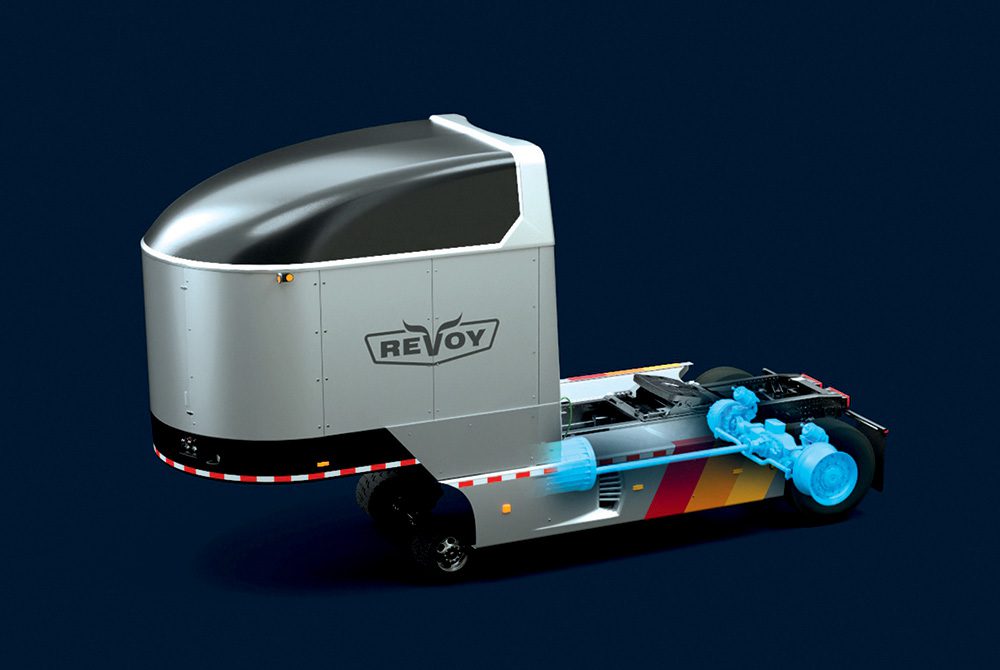
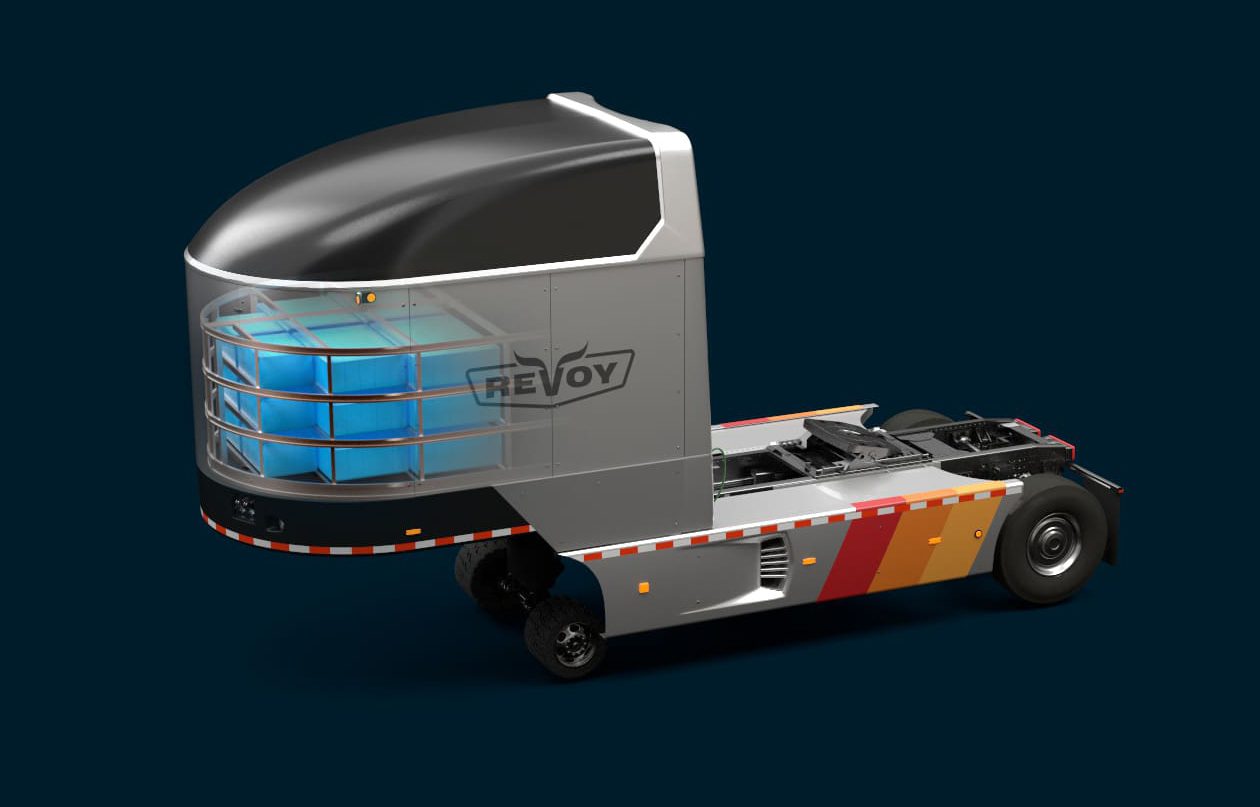
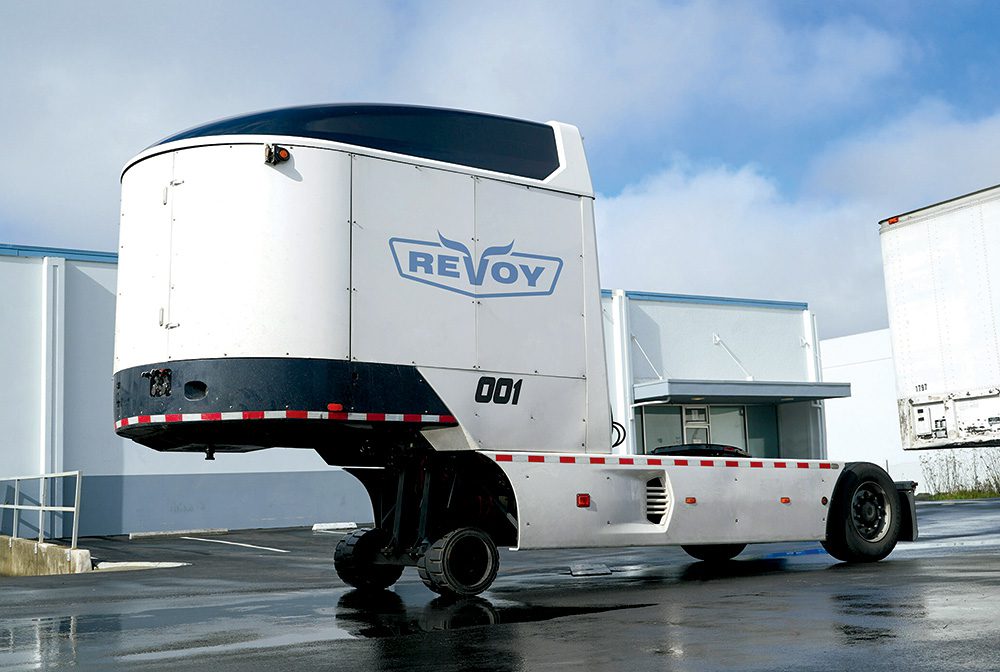
A startup called Revoy offers another type of solution—the Revoy EV is a dolly (technically not a trailer) full of batteries that attaches to a diesel semi-truck to effectively turn it into a hybrid.
Unlike powered trailers made by Range Energy and Trailer Dynamics, the Revoy EV is used with a trucker’s existing, unmodified trailers. Also unlike those companies, Revoy is not selling its product outright, but rather providing it as part of a turnkey service on specific routes.
A startup called Revoy offers a dolly full of batteries that is used with a trucker’s existing trailers.
In 2024, Revoy did a year-long successful technology demonstration with Ryder, operating one such route (in industry parlance, a lane) between Texas and Arkansas. At the company’s swapping station in Dallas, the Revoy EV was attached between a tractor and a semi-trailer, a process that takes about five minutes. The rig then drove 234 miles to a station in Arkansas for another quick swap. The Revoy EV is now in production, and the company is planning to build its first commercial swapping stations in Southern California.
Hello, dolly
The dolly contains a 525 kWh LFP battery pack and a 400 kW electric motor. Range is about 170 miles, and charging typically uses a pair of 360 kW CCS fast chargers, which deliver a full charge in about an hour. The Revoy EV provides enough extra power to increase a rig’s fuel efficiency from 6-8 miles per gallon of diesel to 120 miles per gallon, cutting emissions by 94% and potentially saving a shipper as much as $25,000 in fuel costs per year.
The Revoy EV dolly can increase a rig’s fuel efficiency from 6-8 miles per gallon of diesel to 120 miles per gallon, cutting emissions by 94% and potentially saving a shipper as much as $25,000 in fuel costs per year.
Trucking companies pay by the mile for the service, which is designed to fit smoothly into the current process that shippers use. “What we sell to our customers really is torque,” CEO and founder Ian Rust told reporters in 2024. “They’re just getting power to haul their load.”
Like the powered trailers, Revoy’s dolly is designed not only to save fuel, but to improve the performance of the overall rig. The extra power helps trucks accelerate faster, and the dolly’s regenerative braking decreases the rig’s stopping distance by as much as 30%. Revoy’s technology also adds driver assistance features like blind spot detection, automatic reversing and auto-correction to help prevent rollovers or jackknifing.
Don’t call her a trailer!
“It’s not a trailer because it’s not carrying cargo,” Revoy Chairman Peter Reinhardt explained to Charged. “It’s a dolly. On the National Highway Freight Network [which includes the Interstate system plus a few other major highways], there are restrictions on trailer length, but there are no overall length restrictions on the entire combination. Our dolly is typically included in the length of the whole system.”
There is a regen system, but “it doesn’t end up being that material in terms of fuel savings, since most of the time you’re just cruising down the Interstate. The Revoy EV is really only useful in the National Highway Freight network. It inhabits a specific 170ish-mile lane where it shuttles back and forth between two chargers, and what really drives the economics is high charger utilization.”
The company currently has four dollies in operation. “An economically successful commercial lane probably looks like about 24 Revoys, which is not a huge manufacturing lift, but we think we can get to great diesel-beating economics even at that small scale,” Reinhardt told us. “Then we’ll look to replicate that unit of 24 Revoys across different lanes.”
This article first appeared in Issue 73: July-September 2025 – Subscribe now.
from Charged EVs https://ift.tt/W6FqTHA


No comments:
Post a Comment