The Megawatt Charging System (MCS) is an emerging standard for heavy electric vehicles. It can deliver charging power of up to 3.75 megawatts (3,000 amps at 1,250 volts DC).
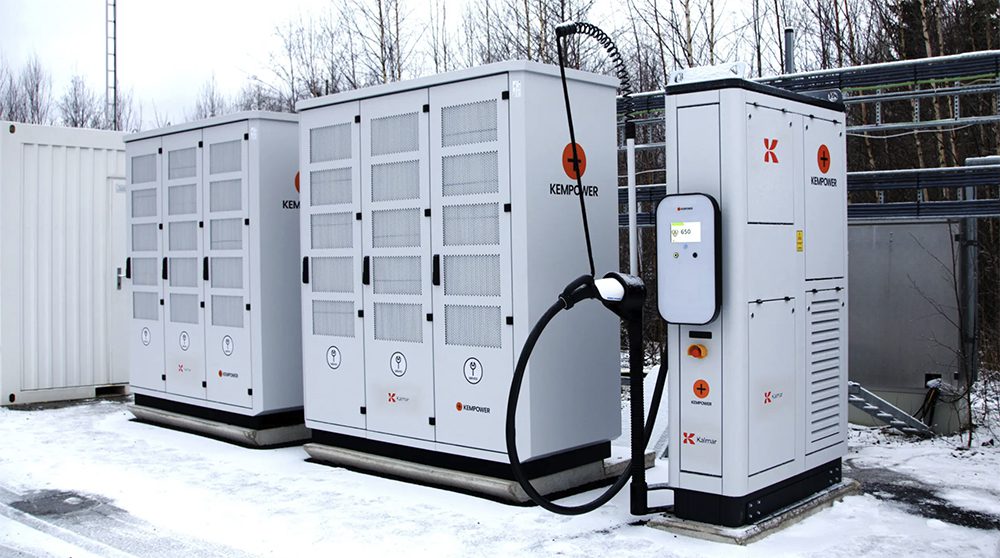
Kalmar, a global provider of material handling equipment and services, has selected Kempower as a strategic partner to develop a new range of DC fast charging solutions for material handling and logistics, focusing on the port segment.
Screenshot
In 2024, DP World and Kempower deployed a 500 A continuous charging system for Kalmar’s electric straddle carriers at London Gateway. The installation of these 12 MCS chargers represents the second phase of the port’s electrification, and it will increase the total power capacity at the site to 11.2 MW.
Jussi Vanhanen, Chief Market Officer at Kempower said: “We are very happy to continue our collaboration with DP World in the electrification of London Gateway, and excited to supply the first MCS chargers to the site. Transfer to MCS significantly decreases charging downtime, accelerating emission reduction and sustainable material handling and logistics at ports.”
Vianode, a Norwegian producer of advanced battery materials, has started site preparation at its new synthetic graphite facility Via TWO in St. Thomas, Ontario.
Production is expected to start in 2028. The site is located in the Yarmouth Yards Industrial Park, close to key automotive customers, and offers access to Ontario’s electricity grid and strong support from local and provincial authorities.
Subject to reaching a definitive agreement, the Government of Ontario will provide a loan of up to C$670 million ($484 million) in support of Vianode’s investment.
The project is structured as a phased multi-billion-dollar investment. The total planned capacity is up to 150,000 tons annually, supporting delivery of synthetic graphite for around two million EVs per year.
Vianode started Norwegian synthetic graphite production at its Technology Center in Kristiansand in 2021 and commissioned its first full-scale plant Via ONE at Herøya in 2024. The St. Thomas facility is part of the company’s goal to supply advanced materials for up to three million EVs annually by 2030.
“Today marks an important step towards a resilient North American battery supply chain. Ontario and the city of St. Thomas have been strong partners from day one, and Via TWO will bring industrial-scale, low-emission graphite to market through a phased build-out that supports customers, communities and the clean energy transition,” said Burkhard Straube, CEO of Vianode.
Electromobility is evolving rapidly. New vehicle concepts, complex E/E architectures, and increasingly powerful battery systems are pushing developers to their limits. At the same time, the pressure to shorten development cycles and reduce costs is growing. In this dynamic environment, one method is gaining significant traction: Software-in-the-Loop (SIL) testing.
What Is Software-in-the-Loop Testing?
SIL testing refers to the virtual validation of ECU functions using simulation models—without any physical hardware. The ECU software runs in a virtual environment and interacts with a digital twin of the vehicle or subsystem. This allows engineers to test functions early, identify errors, and reduce development risks.
Why SIL for Battery Electric Vehicles?
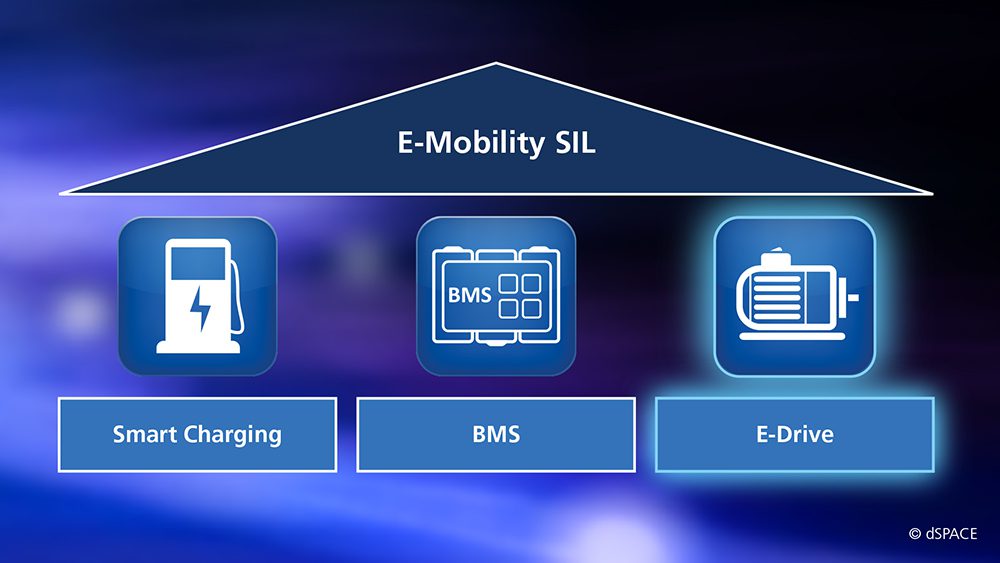
Battery electric vehicles (BEVs) are particularly complex: battery management systems (BMS), charging functions, thermal management, and energy management must work seamlessly together. SIL testing enables:
Early validation of control algorithms, such as for energy management, charging, and thermal management.
Simulation of charging infrastructure and smart charging, including communication protocols like ISO 15118-20.
Testing ofBattery Management Systems (BMS), Simulation of cell behavior and fault conditions to validate safety and efficiency algorithms.
Integration of new E/E architectures, such as zonal controllers or centralized vehicle computers.
Advantages Over Traditional Testing Methods
SIL testing is especially powerful in early development phases. It supports parallel testing, automated regression testing, and seamless integration into CI/CT pipelines. Its scalability allows teams to run thousands of test cases across multiple virtual environments simultaneously, while virtualization enables testing of entire software stacks—including middleware and operating systems—without the need for physical ECUs. The full potential of SIL unfolds through its scalability in cloud applications, which enables the parallelization of tests and thus increased test coverage and speed.
New E/E Architectures: Challenges and Opportunities
Modern vehicles increasingly rely on zonal architectures, where functions are centralized rather than distributed across individual ECUs. This brings benefits in terms of weight, cost, and update capability—but also introduces new validation challenges like modelling the hardware dependencies of ECUs.
SIL testing offers:
Modularity: Individual software components can be tested in isolation.
Flexibility: Architectural changes can be quickly simulated and evaluated.
Reusability: Models and test scenarios can be reused from SIL to HIL, where up to 80% of tests can be executed before the first physical ECU exists.
Virtualization support: Enables testing of containerized applications and service-oriented architectures.
Integration into the Development Workflow: From Code to Feedback in Seconds
One of the key strengths of SIL testing lies in its seamless integration into modern development pipelines. With a powerful API, the entire process—from creating a virtual ECU (VECU) to executing automated tests—can be fully scripted and embedded into existing toolchains.
This means developers can trigger tests directly from their development environments or any CI/CT system. Artefacts generated from source code are automatically built, deployed, and tested—providing instant feedback on whether the implementation behaves as expected. This feedback loop can be part of a pull request, ensuring that every code change is validated before integration.
Even more compelling, OEMs can extend this approach to their supplier networks. Whenever a supplier submits an update, it can be uploaded as an artefact to the cloud and automatically tested within the full virtual vehicle context. This cloud-based validation workflow enables scalable, distributed testing across organizational boundaries—without requiring physical infrastructure or manual coordination.
The ability to run full-vehicle simulations in the cloud also opens the door to on-demand compute scaling, remote collaboration, and continuous integration across global teams. These capabilities are essential for modern development organizations looking to accelerate innovation while maintaining quality and compliance.
SIL Across the Development Lifecycle
While Software-in-the-Loop testing is often associated with early-stage development, its benefits extend across the entire lifecycle of vehicle software. With dSPACE’s SIL solutions, teams can:
Validate software updates continuously, even after SOP, by integrating SIL into over-the-air (OTA) update pipelines.
Support variant management, by testing multiple configurations and feature sets in parallel.
Perform integration testing, by combining multiple VECUs and FMUs into a full system simulation.
Enable long-term regression testing, ensuring that new features do not break existing functionality.
This lifecycle coverage is especially valuable in agile development environments, where software is delivered incrementally and must be validated continuously. With VEOS and its cloud-native capabilities, these tests can be executed at scale on-demand, across teams, and without hardware bottlenecks.
System-Level Integration with VEOS: Beyond Function Testing
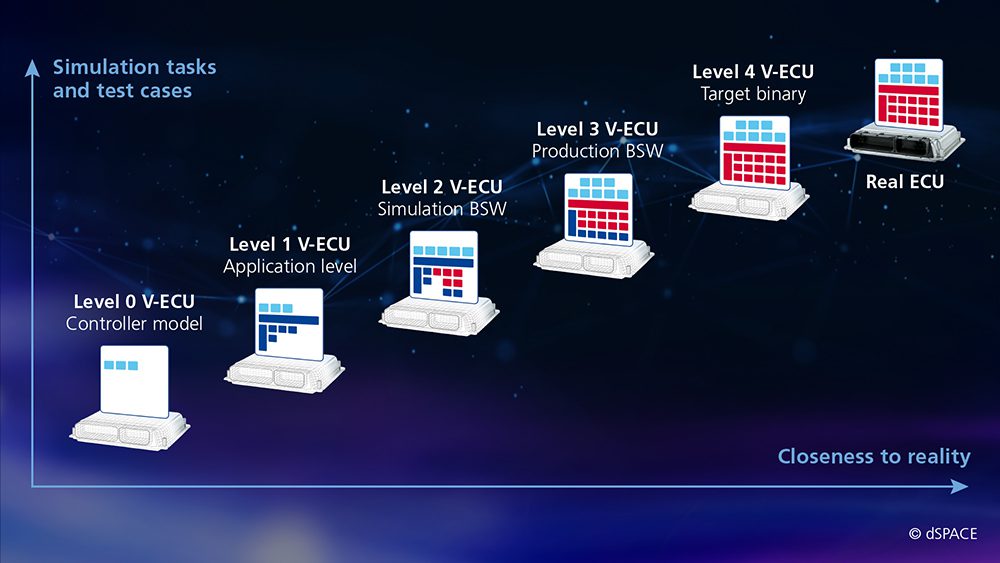
While SIL testing is often associated with function-level validation, the dSPACE VEOS platform goes far beyond that. It enables system-level integration by supporting a wide range of abstraction levels. The abstraction level of a V-ECU provides information about its development status. When it comes to simulation, the following applies: The further the development of the V-ECU progresses, the more details have to be taken into account.
Level 0 and level 1: In the early phases of development, the focus is on validating individual application components. The exact type of signal transmission between V-ECUs is secondary and is usually not yet fully specified.
From level 2: Bus communication and the integration of the V-ECU into an overall simulation are becoming increasingly important. From here, basic software for bus communication must be integrated into the V-ECU. For easier integration and faster creation of the V-ECU, simplified basic software that only includes the communication (COM) module is usually used in earlier development phases.
Level 3: These V-ECUs come very close to the real ECU and ideally only differ in terms of the hardware-dependent driver modules. All basic software located above these modules is part of the test object here and is therefore fully integrated into the V-ECU.
This layered approach allows developers and integrators to select the right level of fidelity for their use case, and to gradually evolve their virtual test environment as the software matures. VEOS supports all these levels and enables their combination in mixed configurations, ensuring flexibility and scalability throughout the development lifecycle.
VEOS is designed to be open and interoperable. It supports integration with third-party simulation and testing platforms, making it possible to build hybrid environments that combine dSPACE tools with external solutions. Whether you’re working with proprietary models, open standards, or commercial software, VEOS provides the flexibility to bring everything together in one cohesive simulation.
VEOS also supports cloud-native deployment models, making it possible to run simulations and tests in scalable cloud environments. This enables organizations to shift from local, hardware-bound setups to flexible, cloud-based validation platforms that support remote access, elastic compute, and global collaboration.
This openness is a key differentiator: it allows OEMs and suppliers to collaborate across tool boundaries, validate across domains, and scale testing across platforms—without being locked into a single ecosystem.
Open Standards and Toolchain Compatibility
dSPACE SIL solutions are built to integrate seamlessly into heterogeneous toolchains. VEOS supports industry standards such as:
FMI (Functional Mock-up Interface) for model exchange and co-simulation.
ASAM XIL for standardized test automation.
AUTOSAR Classic and Adaptive for ECU software integration.
This standards-based approach ensures compatibility with third-party tools and allows customers to leverage existing investments in modeling, testing, and automation infrastructure.
Scalable Deployment: From Desktop to Cloud
One of the key differentiators of the dSPACE SIL ecosystem is its scalable deployment model. Whether running locally on a developer’s workstation or in a high-performance cloud environment, VEOS adapts to the needs of the project and organization.
Local execution is ideal for debugging, and interactive development.
Cloud-based execution enables large-scale regression testing, parallel scenario validation, and global collaboration.
This flexibility allows teams to start small and scale up as needed—without changing tools or workflows. Combined with containerization and orchestration support, VEOS can be integrated into enterprise-grade infrastructures, supporting DevOps practices and continuous validation pipelines.
By bridging the gap between desktop simulation and cloud-native testing, dSPACE empowers organizations to build resilient, scalable, and future-proof validation environments—ready for the demands of next-generation vehicle development.
Conclusion: Virtual Validation as a Key to Scalable, Collaborative Development
Software-in-the-Loop testing is more than just a tool—it’s a strategic enabler for electromobility. It allows for faster innovation, higher quality, and lower costs. Especially for battery electric vehicles and new E/E architectures, SIL testing is an essential part of modern development workflows.
With VEOS, dSPACE offers a powerful, open, and scalable platform that supports full system integration, cross-tool collaboration, and cloud-based validation pipelines—empowering developers and organizations to shape the future of mobility together.
dSPACE empowers developers worldwide to unlock these benefits—with powerful tools, deep expertise, and a clear focus on the future of mobility.
UK-based EV, fuel and business expense payment company Allstar has partnered with First Charge, UK bus operator First Bus’s commercial EV charging service, to expand depot charging access for electric vans and HGVs across 10 UK locations.
The partnership offers depot charging speeds up to 360 kW, larger bays suitable for e-vans and eHGVs, and negotiated pricing to reduce vehicle downtime and operational costs for eligible Allstar customers. The network encompasses more than 28,000 locations in the UK, including more than 76,000 chargers.
Allstar’s work to improve accessibility to EV charging includes solutions for public charging, near-home charging and home charging—and now negotiated pricing as well as integrated payment and reporting solutions for eligible Allstar customers at First Charge’s depot charge points.
“Through First Charge, we are unlocking the potential of our depot charging infrastructure for use beyond our own bus charging needs, helping more fleets access ultra-rapid charging to make the switch to zero-emission vehicles,” said Faizan Ahmad, Decarbonization Director at First Bus.
Molabo, a German manufacturer of high-performance 48 V electric propulsion systems, has unveiled a new serial hybrid system that integrates its low-voltage ARIES drive with Fischer Panda’s lightweight and compact AGT-series generators.
Developed for Team Malizia’s IMOCA racing yacht, the new hybrid system allows boatbuilders to combine electric operation and generator-assisted cruising, offering flexible and ultra-efficient energy management for long-range or high-demand applications. All components operate at 48 VDC to ensure safety and ease of installation without specialized high-voltage certification or equipment.
By combining Molabo’s safe-to-touch propulsion technology with Fischer Panda’s generator expertise, the hybrid platform is designed to offer a scalable, future-ready solution for OEMs and shipyards seeking to deliver low-emission electric and hybrid vessels without the complexity of high-voltage systems.
Because the entire system operates at low voltage, it can be installed by trained shipyard staff without slowing production lines. Owners retain access to Fischer Panda’s worldwide service network for the gensets, while most marine electricians can safely maintain Molabo’s 48 V ARIES drive. The 6-22 kW integrated DC generators are compatible with hydrotreated vegetable oil.
“This new system builds on everything that makes the 48 V platform so effective,” said Tommi Salonen, Head of Global Marine Sales for Molabo. “It delivers extended range and performance for larger vessels or bluewater cruising yet remains simple to install and maintain. The integration with Fischer Panda provides a ready-to-implement hybrid solution that fits seamlessly into existing production workflows.”
Molabo has also developed a new ARIES 50 kW jet-drive in partnership with Kaiser Bootsmanufaktur, demonstrating the adaptability and performance of the electric propulsion platform in compact, high-efficiency applications.
Samsung SDI, BMW and US battery technology company Solid Power have signed an agreement to work together on establishing global value chains for all-solid-state batteries across materials, cells and EVs.
The collaboration aims to pave the way for the commercialization of all-solid-state battery cells by bringing together their complementary expertise in cell manufacturing, automaking and materials development.
Under the partnership, Samsung SDI will supply battery cells using the solid electrolyte developed by Solid Power. BMW will develop modules and packs for the cells. The three companies aim to evaluate the performance of the cells based on the agreed parameters and requirements and to integrate them into BMW’s next-generation evaluation vehicles.
Samsung SDI and BMW have collaborated since 2009, when the German automotive group chose the South Korean firm as a battery supplier. In March 2023, Samsung SDI established a pilot line at the Suwon R&D Center in South Korea, and it began producing prototypes at the end of 2023. Sample tests are currently underway in collaboration with multiple customers. The battery developer outlined its roadmap for mass production of all-solid-state batteries last year. It plans to mass-produce 900 Wh/L solid-state batteries using its solid electrolyte and anode-less technologies.
“Our solid electrolyte technology is designed for stability and conductivity, and by working closely with global leaders in automotive and battery innovation, we strive to bring ASSB technology closer to widespread adoption,” said John Van Scoter, President and CEO of Solid Power.
Contemporary Amperex Electric Vessel (CAEV), a subsidiary of Chinese battery giant CATL, has launched a “zero-carbon shipping and integrated smart port solution,” called Ship-Shore-Cloud.
CATL has delivered nearly 900 electric ships, setting multiple records, and has learned that electric ships are not simply adaptation of land-based technologies. “Their development needs to face the challenges of harsh operating environments such as high humidity, high salt spray, long-duration voyages, and high power requirements,” the company explains.
In traditional ship operations, power supply, energy replenishment and maintenance services are often provided by separate suppliers. The resulting coordination challenges and ambiguous accountability represent “the core bottleneck restricting the large-scale development of zero-carbon shipping,” according to CATL.
To address these challenges, CATL has launched its Ship-Shore-Cloud solution, which integrates everything from the ship’s on-board power system and shore-based energy replenishment network to cloud-based intelligent management.
On the ship side, the system integrates battery systems, power systems and intelligent navigation systems to ensure the stable long-distance operation of ships. On the shore side, it separates the management of ships and batteries through a charging and battery-swapping network. In the cloud, enabled by the intelligent management platform Yunfan and the intelligent navigation system Beichen, ships can be remotely monitored, scheduled and optimized.