Lider Electric’s NEMA 14-50 receptacles with Electric Vehicle Marking combine certification-backed product identification with purpose-built EV charging design.
EV charging reliability is often discussed at the system level: charger output, vehicle compatibility, software, utility capacity, and public infrastructure. Those factors matter, but many residential and light commercial charging setups still depend on a physical component that can be easy to overlook: the receptacle.
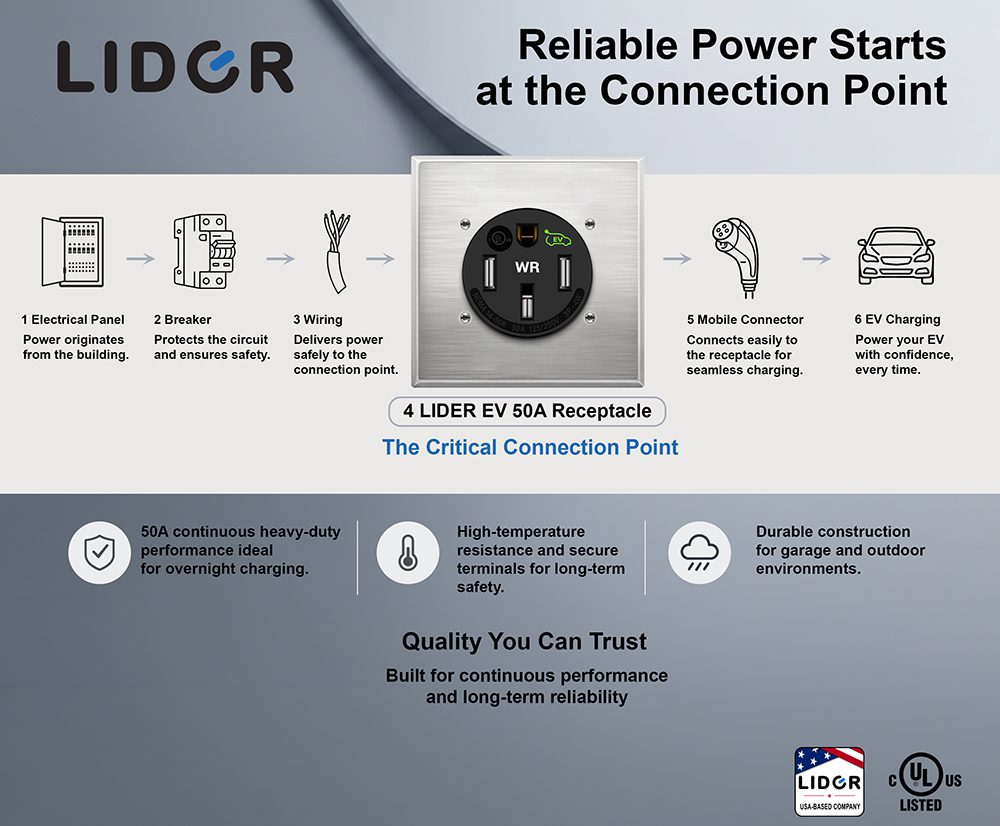
For plug-in Level 2 charging, the NEMA 14-50 receptacle is where the building’s electrical system meets the charging equipment. It is the point where wiring, contact pressure, mechanical fit, heat, repeated use, and installation quality all come together. From the outside, it may look like a standard wiring device. In daily EV charging, it becomes part of the charging infrastructure.
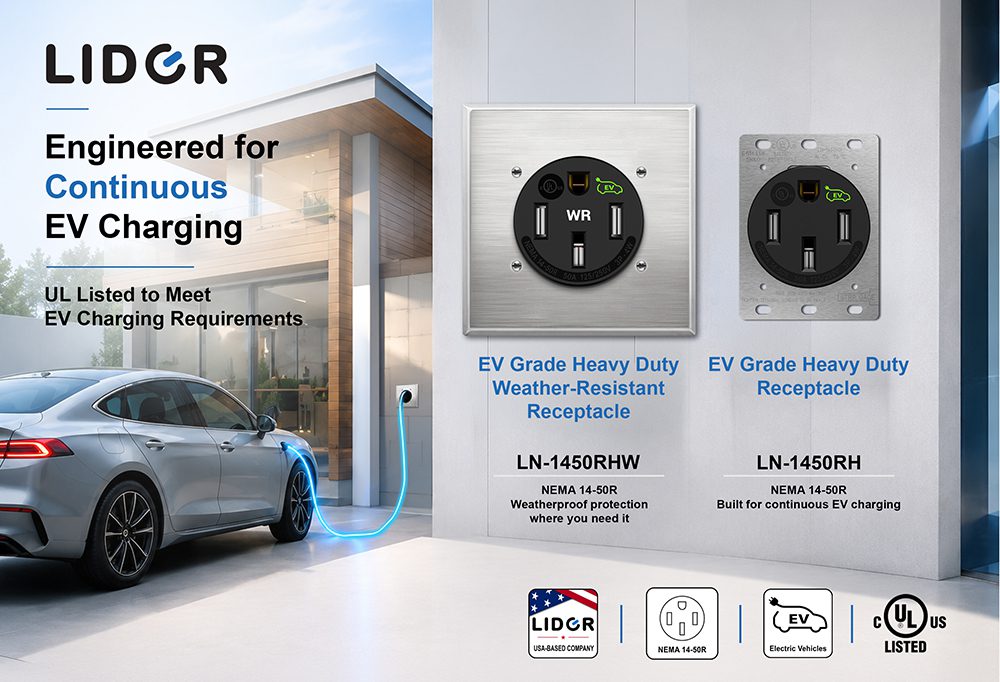
That connection point is the focus behind Lider Electric’s LN-1450RH and LN-1450RHW NEMA 14-50 receptacles. The latest UL certification documentation identifies these models with Electric Vehicle Marking, giving installers and customers a clearer way to recognize their EV-related certification status. Together, the certification, marking, and product design reflect Lider Electric’s focus on safety-conscious product development, connection reliability, and long-term charging performance.
Why EV Charging Changes the Role of the Receptacle
EV charging is not a one-time electrical event. For many drivers, it is a repeated duty cycle: plug in, charge for hours, unplug, and repeat. That pattern places sustained demand on the electrical pathway, especially in garages, driveways, workshops, multifamily properties, and light commercial environments.
In that environment, product selection should go beyond plug configuration and price. A receptacle used for EV-related applications should be evaluated with daily use, sustained electrical load, secure wiring connections, heat management, and long-term durability in mind.
The receptacle also does not work alone. Breaker selection, wire sizing, grounding, enclosure selection, terminal torque, local code compliance, and qualified installation all matter. But the receptacle is where electrical performance becomes physical contact, making it an important part of the overall charging setup.
Designed for Sustained EV Charging Use
Lider Electric’s approach to NEMA 14-50 receptacle design starts with how EV charging is actually used. It is designed around repeated charging sessions, sustained electrical demand, and the need for reliable connection performance over time.
The LN-1450RH and LN-1450RHW are rated 50A, 125/250V and engineered for EV-related installations where long-duration charging performance matters. Their design priorities include reliable power at the connection point, heavy-duty NEMA 14-50 construction, secure connection performance under sustained electrical load, contacts designed to support heat resistance during extended use, and clear product identification through Electric Vehicle Marking.
That matters in a market where products can appear similar in online listings. Two receptacles may share the same configuration, but differ in internal construction, contact design, material selection, terminal strength, and certification status. For installers and buyers, those details can influence how confidently a product is selected for an EV-ready electrical upgrade.
Lider Electric’s position is straightforward: for daily EV charging, product selection should not be based on price and plug configuration alone. The company focuses on engineering, materials, safety-conscious product development, and dependable performance so EV owners and trade professionals can make more informed decisions at the connection point.
Inside the Engineering
Lider Electric’s EV charging receptacle design focuses on internal components that support stable connection performance under sustained use. Key design details include:
Fortified nylon enclosure reinforced with glass fibers to support durability, heat resistance, and wear resistance
Silver-plated solid H65 brass contacts designed for conductivity and resistance to oxidation
V-shaped high-purity ETP copper clamp with Cu ≥ 99.9%, designed to hold stranded and solid wires securely
Max 75 lb-in torque hexagon terminal screws designed to support secure installation when installed according to applicable requirements and professional practices
Self-grounding design to help provide a reliable ground path when properly installed
Electric Vehicle Marking for clearer product identification in EV-related applications
These engineering choices reflect the same principle that shapes the broader product design: EV charging reliability starts with the quality of the physical connection.
The Difference Between Claims and Certification
The EV charging market includes many products that claim to meet applicable standards. However, there is an important distinction between a self-declared claim and a product that has completed the applicable certification process. In practical terms, certification matters because it gives installers and customers a documented basis for product evaluation, as long as the certification reference matches the authorized UL Mark and certification scope.
For homeowners, commercial users, electricians, contractors, builders, and EV installation professionals, that distinction matters. UL certification provides a clearer reference point when evaluating products for EV-ready residential and commercial projects. It helps move the buying decision beyond marketing copy and toward documented certification.
For Lider Electric’s LN-1450RH and LN-1450RHW, the latest certification documentation identifies a NEMA 14-50 receptacle platform with Electric Vehicle Marking. Electric Vehicle Marking helps identify receptacles that have been evaluated under UL certification requirements for EV-related use. For installers, inspectors, and customers, it is more than a label; it is a practical product identification tool in a category where clarity is increasingly important.
According to the UL Certificate of Compliance, representative samples of Lider Electric’s LN-1450RH-** and LN-1450RHW-** have been evaluated by UL in accordance with the Standard(s) indicated on the Certificate. For the U.S. Listing, the certificate references “UL 498 – Attachment Plugs and Receptacles.” The Models section specifies “LN-1450RH-** Electric Vehicle Marking – Suitable for USL only” and “LN-1450RHW-** Electric Vehicle Marking – Suitable for USL only.”
For electricians and EV installation professionals, clear product identification can support more consistent specification and selection. When a receptacle is marked and documented for EV-related use, it gives installers another reference point when planning a charging setup.
For builders and property managers, EV readiness is becoming part of long-term property planning. Selecting components designed around real charging behavior can support more future-ready electrical projects.
For EV owners, the takeaway is simple: dependable charging begins before the vehicle is plugged in. It starts with the electrical pathway, the quality of the installation, and the reliability of the receptacle at the connection point.
Built Around a More Demanding Charging Future
As EV adoption continues to grow, expectations for charging infrastructure should grow with it. Charging speed and convenience will remain important, but so will the quality of the components behind the wall. The receptacle may be small compared with the charger or the vehicle, but it plays a meaningful role in supporting daily charging performance.
Lider Electric’s NEMA 14-50 receptacles with Electric Vehicle Marking reflect that approach. The LN-1450RH and LN-1450RHW are designed for EV charging environments where connection reliability, product identification, secure installation, and long-term performance matter.
Volvo Buses will supply 38 Volvo BZR Low Entry Electric buses to the City of Cape Town, South Africa. The buses will operate within the city’s electric passenger transport system.
“This is a landmark project for both Cape Town and for us. We can be very proud to introduce electric buses to the city, and in doing so, prove that we acknowledge and support a sustainable future,” says Leon Nelson, Director, Volvo Buses in South Africa.
The Volvo BZRLE Electric is based on Volvo’s’ flexible BZR platform. The bus bodies will be locally designed and manufactured by Gauteng Bus and Coach Centre in Johannesburg. The charging infrastructure will be managed by the City of Cape Town.
Volvo Buses has acted as a strategic advisor throughout the electrification process, supporting infrastructure planning and system implementation.
“The first buses are scheduled for delivery in 2027,” says Rob Quintas, City Councillor responsible for urban mobility in Cape Town. “We have ordered a minimum of 38 buses, but this number may increase with funding availability. The new buses will be paid for by means of Public Transport National Grant funding.”
“This project demonstrates how electrification can be implemented in a way that strengthens local capabilities, builds technical competence, and contributes to the development of a future-ready public transport ecosystem,” says Manish Sahi, Vice President, Volvo Buses MIAC.
Corvus Energy’s new Blue Whale NxtGen Power is a lithium iron phosphate (LFP) energy storage system designed for electric vessels that need high power rather than high capacity. The system was developed in collaboration with BYD Energy Storage—the first product to result from the two companies’ strategic cooperation.
BYD Energy Storage provides the battery cell technology and cell stack manufacturing, and Corvus handles the overall system design and architecture, including marine safety features, the BMS, cybersecurity, a digital battery passport and class approval, as well as final assembly, testing and lifetime service support.
Blue Whale NxtGen Power is built on Corvus’s existing NxtGen platform, and it shares its stack interface, battery module design, BMS and cell string assembly with the rest of the NxtGen portfolio. For existing Blue Whale NxtGen customers, Corvus says installation practices, service procedures and spare parts management stay largely unchanged, so common spare parts carry across products and training needs should remain low.
Corvus lists tugs and workboats, offshore vessels that use batteries for power optimization and large ferries that need rapid charging between crossings as the main applications for a system built for vessels where power demand, rather than energy capacity, defines performance.
“LFP technology has advanced significantly in recent years and now offers a highly cost-effective solution for a wide range of maritime applications. By combining BYD Energy Storage’s technology leadership, manufacturing expertise and global scale with Corvus Energy’s maritime experience, we can accelerate innovation, reduce system costs and deliver even greater value to our customers,” said Thor Humerfelt, Head of Product Innovation at Corvus Energy.
EV charging giant ChargePoint, together with intelligent power management company Eaton, will provide EV charging infrastructure for Big Blue Bus, a public transit agency that serves the city of Santa Monica and the greater Westside region of Los Angeles County.
The Santa Monica Department of Transportation aims to operate a fully zero-emission fleet by 2032.
As part of Santa Monica’s $56-million investment in electric transit fleet infrastructure, the current project combines ChargePoint’s DC fast charging solutions and fleet software with Eaton’s electrical infrastructure and energy management solutions.
Big Blue Bus plans to deploy 130 DC fast charging ports, exclusively featuring the Express Plus line of ChargePoint equipment. Eaton is providing electrical infrastructure, including medium-voltage switchgear, switchboards, panelboards, as well as engineering expertise.
“This project represents one of ChargePoint’s largest transit deployments to date, showcasing how our scalable, high-power charging solutions can meet the complex needs of large bus fleets and help agencies transition to fully electric operations while delivering a lower total cost of ownership,” said Rick Wilmer, CEO at ChargePoint.
“By investing in clean, electric transit, we’re creating healthier air for our communities, a quieter and more comfortable experience for riders, and a safer, more efficient environment for our workforce,” said Anuj Gupta, Director of Transportation for the City of Santa Monica.
“Whether you’re electrifying a fleet or a personal vehicle, Eaton is making electrification easier, faster and more flexible—helping customers maximize infrastructure investments, optimize energy use and unlock greater value from the grid,” said Paul Ryan, Vice President and General Manager, Energy Transition at Eaton.
Coulomb Solutions (CSI), a provider of commercial electrification and energy storage products, is adding Megawatt Charging System (MCS) support to its newest-generation Mobile Battery Energy Storage Systems.
CSI’s optional architecture incorporates MCS on both the input and output sides. This allows the system to be rapidly recharged through an MCS connection, and to provide high-power MCS charging directly to commercial EVs.
CSI’s Mobile Battery Energy Storage Systems offers two MCS configurations:
The 699 kWh Mobile BESS offers up to 700 kW of MCS input/output power. It’s designed for mobile fleet charging, temporary deployment, vehicle testing and infrastructure-constrained locations.
The 2.3 MWh Mobile BESS offers up to 1 MW of MCS input/output power. It’s designed for heavy-duty fleet applications including Class 8 trucks and buses, ports, industrial and large-scale temporary charging applications, eVTOLs, marine, construction, and agriculture applications.
Both systems are eligible for a point-of-purchase rebate of up to $300,000 under the 2026 CORE Voucher Funding program.
CSI’s BESS systems also feature standard 480 VAC recharging capabilities. The 480 VAC connection is also bidirectional, and can support building loads, shave peaks to minimize demand charges, and shift energy usage from peak to off-peak periods.
“CSI’s approach completely changes how fleets can think about megawatt charging,” said CEO David Mazaika. “This allows CSI’s BESS systems to take advantage of the substantial megawatt-charging infrastructure being installed everywhere to charge very quickly and then transport the energy to a fleet depot to charge EVs as needed.”
“Commercial electrification cannot always wait for the grid,” said Greg Laudermilch, Vice President, Sales and Marketing. “Mobile energy storage allows the charging infrastructure to move with the demand. Adding MCS capability takes that concept to an entirely new power level.”
Wevo has developed WEVOPUR 60210 FL T, a polyurethane compound for the selective potting of multilayer printed circuit boards in automotive battery management systems. The system is applied by the dam-and-fill method and is built for boards that monitor and control voltages of up to 800 V in electric vehicles.
Diagnostic, communication and safety functions have pushed up the integration density of these boards, which have to withstand mechanical stress, changing environmental conditions and high operating temperatures. Potting encases a circuit board in a cured compound, a common way to shield automotive electronics from vibration, moisture and heat, and selective potting applies it only where it is needed so connectors and testing points stay accessible.
The compound has a Shore hardness of D 40 to 50 and a thermal conductivity of 0.8 W/m·K, and its dielectric strength exceeds 20 kV/mm. According to Wevo, the material absorbs shocks, vibrations and the stresses that come from fluctuating temperatures, and moving heat through the potted assembly helps reduce temperature differences between components and lowers the risk of stress cracks and solder joint detachment. The company adds that the cured compound fixes the components in place, is formulated to prevent electrochemical corrosion and protects them from moisture, and that optimized adhesion forms a durable bond with the substrate to help prevent delamination.
In the dam-and-fill process, the compound works as both barrier and filler. Wevo says the flow behavior and thixotropy are tuned so the barrier holds its shape while the filler wets the area to be protected without trapping air pockets. Layer thickness and the amount of material can be adjusted to different PCB geometries by changing the process design and application speed.
Wevo formulated the system to run on standard two-component mixing and dosing equipment, which the company says reduces the work involved in material qualification, storage and process management.
Swiss dairy company Emmi Schweiz has deployed three electrified refrigerated trailers from Nivalis Energy Europe as part of its efforts to reduce emissions from its refrigerated transport fleet. Now operating on live distribution routes, the trailers power their energy-intensive refrigeration systems using dedicated battery systems, preserving the e-trucks’ battery capacity for driving.
One of Switzerland’s largest dairy companies, Emmi supplies milk, cheese, yoghurt and other chilled products through an extensive refrigerated distribution network. Each of the new electrified trailers will travel an average of 200-400 kilometers per day—the refrigeration units normally operate for around 6-10 hours daily.
Unlike a conventional refrigerated trailer, which relies on a separate diesel-powered Transport Refrigeration Unit (TRU), the Nivalis platform powers refrigeration using an onboard battery energy system. As Emmi’s trucks are also fully electric, the Nivalis Reefer avoids reducing the EV truck’s driving range.
The Nivalis platform’s modular architecture enables fleets to configure a combination of battery, rooftop solar and regenerative e-axle technologies according to their specific operating requirements. For Emmi’s urban distribution routes, the trailers, manufactured by Ackermann Fahrzeugbau, have been equipped with Nivalis’s battery-electric refrigeration platform—which uses a Mitsubishi TEU1300SA refrigeration unit—and seven rooftop solar panels.
“Our customers depend on us to deliver chilled products safely and reliably every day, so any new technology must integrate seamlessly into our existing operations,” said Emmi’s Head of Fleet Management Stefan Leyers. “Since entering commercial service in June, the trailers have performed reliably, and we’ve been very pleased with the results. The experience and operational data we’re gaining from their deployment will help inform the next steps in our longer-term fleet electrification journey.”
“Electrification will only be adopted at scale if it fits naturally into the way fleets already operate,” said Pavel Gilman, VP Sales & Project Management at Nivalis Energy Europe. “Every fleet is different, so the future isn’t a one-size-fits-all approach—it’s giving operators the flexibility to deploy the right combination of technologies for their business. That’s why our platform is modular, allowing customers like Emmi to electrify refrigerated transport in a way that complements their existing operations.”
As the world accelerates towards a sustainable future, the electrification of commercial vehicles is becoming increasingly imperative. This articleexplores the rising demand for megawatt charging solutions in the electric commercial vehicle industry, technical hurdles, cost-efficiency, and performance advantages. We will delve into the costs to enable megawatt charging onboard commercial vehicles.
These technical enablers must be understood when evaluating the vehicle’s desired performance and charging speed. Here we will review these key technological requirements, including high-capacity batteries, high fault current protection systems, and advanced thermal management systems. Each of these can be a limitation on available charging speed of the vehicle but addressing them comes at additional cost.
Using an analysis of available time in the usage of commercial vehicles in a variety of business models, we will identify required charging speeds to electrify that business model. The flexibility of when and where to charge a vehicle becomes the primary benefit of faster charging. We present 3 potential business models that will require different charging solutions:
Local Delivery – Low energy use with high available downtime can be electrified with relatively slow 150kW charging. Medium Haul – Medium energy use with medium available downtime can be electrified with currently available charging speeds of 350kW. Long Haul – High energy use with low available downtime will require 1MW charging to be widely available before electrification.
While all BEV applications could benefit from the flexibility of faster charging, and in fact, potentially most applications could be electrified with widely available 1MW charging. It is important to understand that not all will require megawatt charging. Many business models can go fully electric and manage vehicle cost by using slower charging speeds.
Through innovative research and development, Eaton is at the forefront of developing scalable and efficient onboard charging solutions and can help OEMs and fleets understand the trade-offs between cost and benefit specific to each vehicle’s application.
Cost of Faster Charging
Central to this discourse is the concept of charging speed, a pivotal factor influencing the practical deployment and utilization of electrified vehicles. Charging speed dictates the operational dynamics, dictating the feasibility of various business models transitioning to electrification. While some applications may seamlessly integrate electric vehicles (EVs) into their existing business frameworks, others may necessitate the advent of novel technologies or creation of new business models to utilize the strengths of electrification.
The assertion that expedited charging equates to superior performance holds merit; however, a comprehensive analysis of the constraints faced by vehicle manufacturers and fleet operators is imperative. This encompasses evaluating the technical and economic implications of vehicle electrification, ensuring that the transition is not only technologically viable but also sustainable in the long-term market landscape.
Battery Cells
Battery cells, akin to the human preference for climate-controlled environments, exhibit optimal performance within specific temperature parameters. Ideally, these cells operate efficiently within a thermal window of 15 to 35 degrees Celsius. It is noteworthy that the preferred operational temperature range may vary contingent upon whether the cells are in the process of charging or discharging. Figure 1shows the relationship between the temperature of a battery cell and its relative performance. The performance range is greater during battery discharge than during charging.
Figure 1: Battery Performance vs Cell Temperature
This analogy underscores the necessity for sophisticated thermal management systems in electric vehicles (EVs). Such systems are designed to maintain the battery cells within their ‘comfort zone,’ thereby ensuring consistent performance. Furthermore, integrating intelligent features like route planning enables the vehicle to anticipate upcoming charging sessions, allowing for the pre-conditioning of the battery. This proactive approach facilitates optimal charging efficiency.
The second factor that can affect a cell’s ability to take in energy is its current state of charge. Drawing a parallel to the process of individuals entering a movie theater and finding a seat, charging a battery pack can be conceptualized similarly. When the ‘theater’—or battery pack—is unoccupied, the process is straightforward. However, as occupancy increases, finding available ‘seats’—or charging points within the cells—becomes increasingly challenging. Figure 2 shows this relationship graphically. As the state of charge approaches full capacity, the rate of charging can degrade to the point at which charging is uneconomical. The driver will be better served driving to a second charging location using energy and plugging in at a lower state of charge than to sit and wait at the reduced speed.
Figure 2: Charging Power vs State of Charge
This state of charge relationship can also effect a vehicle’s ability to use the drive motor as a secondary retarder. Therefore, a vehicle must maintain a sizable buffer in the battery pack to ensure sufficient charge rate and storage to perform regenerative braking. A sophisticated route planning tool should be able to predict energy consumption as well as predicted energy recovery to optimize efficiency.
Battery Size and C-rate
A critical aspect of battery chemistry is the relationship between a pack’s peak theoretical charging speed and its capacity. The pursuit of faster cell chemistries is achievable; however, it often entails higher costs and compromises longevity. The commercial electric vehicle (EV) market has shown a predilection for Lithium Iron Phosphate (LFP) chemistry, which strikes a balance between cost-effectiveness and durability.
Recent advancements in LFP chemistry have elevated the pack’s C rate from approximately 2 to 3-4. However, even with a C rate of 3, to attain a charging power of 3.75 MW—the upper limit of the Mega Charging Standard (MCS)—a vehicle would require an onboard battery capacity of nearly 1,000 kWh. Conversely, a charging power of 1MW could be achieved with a 400kWh battery. While substantially larger than the batteries found in light vehicles, this size remains within a more manageable spectrum.
Figure 3 shows this relationship at various theoretical C-rates.
The highlighted example shows that a 3C battery connected to a 1 Megawatt-capable charger will be limited in charging speed if the battery is below 350 kWh. Above that size, the charger’s max power can be achieved.
It is important to note that a larger battery not only extends the vehicle’s range and accommodates greater energy recovery through regenerative braking but also impacts the vehicle’s cargo capacity. This trade-off highlights the intricate balance between enhancing EV performance and maintaining practical utility.
Potential Thermal Bottlenecks
In the context of charging, thermal constraints are a significant consideration. Each element within the battery and charging infrastructure is susceptible to becoming a constriction point. The losses within the electrical system adhere to the I2R rule, indicating that resistance losses are proportional to the square of the current. When currents range from 800 to 3000 Amps, even marginal increments in resistance, particularly around contactors, can lead to substantial heat generation.
Figure 4: The thermal duration curve for Eaton’s Breaktor 900
Figure 4 shows the thermal analysis of Eaton’s Breaktor® circuit protection technology. It provides insight into these dynamics, showing an ability to carry 350A continuously, but much higher currents for limited durations. Incorporating active cooling mechanisms can enhance the duration for which components can operate within safe thermal parameters.
It is crucial to recognize the individual limitations of each component and manage thermal thresholds at the system level to ensure safe and efficient operation. The best way to manage this onboard a vehicle is using temperature sensing and transfer functions to monitor the internal temperature of components. Using an active monitoring system will allow a vehicle to demand maximum power for as long as possible while staying within thermal limitations.
Power Distribution
High-voltage system design encompasses not only the operational parameters but also the protection strategies required to ensure safe operation and minimize the impacts of a fault event. In scenarios where multiple battery packs are employed, each pack may necessitate the management of only a segment of the charging current and exposure to a proportional segment of potential fault conditions. For this reason, each pack’s Battery Disconnect Unit (BDU) may resemble the requirements of a light vehicle application.
Figure 5: An example HD BEV with MCS using Breaktor and Eaton EV Fuse
As shown in Figure 5, Breaktor 900 emerges as an optimal protection solution for individual battery packs. Individually capable of handling 500kW charging for a limited duration and safeguarding against faults up to 20 kA, it meets the requirements of the individual pack after the MCS power is divided evenly. However, its capabilities do not extend to the high currents encountered at the MCS port.
At the MCS port, the system must be fortified against full system faults from either the charger or multiple battery packs at once. This could be a fault current of up to 70 kA. The protection mechanism here is required to be current-limiting to shield the vehicle systems effectively. This is where Eaton’s truck series EV fuses become particularly relevant. These fuses can be arranged in parallel to forge a scalable protection strategy that spans the entire MCS current spectrum. Nonetheless, these fuses must be meticulously coordinated with a suitably sized pair of contactors to facilitate normal switching operations, ensuring a robust and reliable high-voltage system design.
Charging Session
Synthesizing the elements, let’s visualize an actual EV charging session. Calculating charging time lies in the area under the curve. Most charging systems are current-limited, meaning there is a maximum current output for the charger. Multiplying this by the system voltage will yield maximum peak charging power. Enhancing the current limit on either the charger or the vehicle —through thermal mitigation strategies or the augmentation of contactors, for example—can elevate the peak charging speed, thereby diminishing the duration required for a full charge.
Table 1 and Figure 6 show three theoretical charging sessions with different current limitations
Figure 6: Visualizing Charging Sessions
In scenarios involving 1MW and 500kW charging sessions, the system sustains the peak charging rate only transiently before thermal bottlenecks or intrinsic pack limitations necessitate a reduction in charging speed. Conversely, a low-power charging application, operating beneath these thresholds, can maintain peak speed for the majority of the charging duration. All three charging sessions deliver the same 600kWh, but it takes substantially different amounts of time to do so.
These charging profiles are pivotal for Original Equipment Manufacturers (OEMs) and fleet operators to comprehend. They must align the vehicle’s charging capabilities with its designated operational role. This alignment is crucial in ensuring that the vehicle’s performance meets the expectations set by its intended use case. Next, we will delve into how these considerations translate into practical applications for OEMs and fleet operators.
Required Charging Speed
In order to understand how fast is fast enough, we must first examine a selection of commercial vehicle applications. Using a combination of real-world data from the NACFE Run on Less initiative and a theoretical long-haul trucking application, we will look at the amount of energy used in a day vs the available time a vehicle has to charge.
Local Delivery Application
The first application is a local delivery vehicle from for NACFE data provided by Penske. In this application, the vehicle performs a short local delivery route covering approximately 200 kilometers each day in a single shift. This means the vehicle only uses about 250kWh and has over 15 hours of downtime at the depot to add back charge. Theoretically, this could be managed by commercially available level II AC charging, but the vehicles would have to be plugged in the entire time they are not moving. In practice, Penske uses 150kW DC fast charging that is able to refill the truck in 2 hours at the end of its shift before the truck can be moved to a regular parking spot at the depot; this concentrates the infrastructure required to handle multiple vehicles and keeps them operationally flexible. Table 2 and Figure 7 represent this application.
Figure 7: Local Delivery Available Time
Regional Delivery Application
The second example to examine is also from the Run on Less Electric Depot. Here, Pepsi is running a fleet of Tesla semi-trucks on a regional delivery route. The vehicle travels up to 965 kilometers in a 24hr period over two driving shifts. This leaves a limited window at the end of each shift of 3 hours to add back charge. Using a similar method of looking at all available time, this could theoretically be managed by 250kW charging, but again that would require maximum charging for every moment the vehicle is not moving.
In practice, Pepsi uses 600kW charging to refill the trucks in 2 two two-hour sessions, giving increased flexibility and potential uptime. Table 3 and Figure 8 show this application.
Figure 8: Regional Delivery Available Time
Long Haul Application
The last scenario to review is a theoretical example of a long-haul sleeper cab. This is often considered one of the hardest applications to electrify because it currently relies on a dispersed network of refueling stations rather than a controlled depot that is owned by the fleet or operator.
Legally, long-haul drivers in most countries are required to take rest at certain intervals. In an ideal state, the 10-hour rest period as well as all regular stops during the day would be available to charge the vehicle; an operator would be able to cover 965 kilometers per day and only require 150kW charging. But with the distributed nature of where this charging would need to occur, consistently finding a plug every time the truck is not moving will likely be impossible.
For this reason, we must assume the truck is only able to find a plug a limited number of times during the day and does not plug in during its overnight rest period, reducing the available window to charge down to around 3 hours per day. This more closely models the business model used today with rest stops and diesel refueling stations. Using this available time, adding back the required range theoretically requires an average of 666kW charging. Understanding everything we have learned about charging limitations, peak charging, and flexibility, a 1MW or higher charger will be required. Table 4 and Figure 9 represent this theoretical scenario.
Figure 9: Long Haul Available Time
This is not to say megawatt charging solves all issues associated with electrifying long-haul trucking; charger availability and grid connection will be challenging. But this analysis shows that if 1MW charging is widely available, electrifying even the most difficult business case could become a reality.
How Fast is Fast Enough?
Finally, let’s pull the whole picture together. Each application will exhibit a different amount of energy used during the day vs the available time to charge. Figure 10 represents this graphically with shaded regions to represent the three applications examined. By graphing the curves of different peak charging rates, we can identify a threshold below which an application could feasibly be supported by a given charger.
Figure 10: Required Energy vs Available Time
Incorporating the three examples we examined into this graph reveals how each could be accommodated by a distinct charging network. It also indicates that a majority of applications could be adequately served by the widely available 1MW charging infrastructure.
While the MCS standard does permit charging capacities of up to 3.75MW, it’s important to note that the costs associated with enabling such high-power charging tend to increase exponentially. Therefore, the financial justification for enabling such high-power charging will likely be limited to niche applications. This approach ensures a balance between operational efficiency and cost-effectiveness.
Each commercial vehicle application will be unique and require a unique assessment of its energy requirements and business case for electrification. Understanding the limitations and cost of increasing charging performance allows fleets and OEMs to analyze cost vs the flexibility benefits afforded by faster charging. There is no one-size-fits-all answer. Many applications can be adequately served by the charging technology of today and the advent of widely available Megawatt charging should open the window of electrification to most of today’s commercial vehicle applications.
About Eaton: Eaton has long been a leading supplier in the commercial vehicle space. As our product portfolio grows for electrification, Eaton is the ideal partner for OEM customers to understand that cost-benefit equation. Our expertise in power distribution and protection can help OEMs design cost-effective high-voltage architectures that meet their customer’s needs.
ChargeZone operates a public EV charging network with more than 15,000 charging points across 1,200 locations in India and the UAE. The company supports electric passenger and commercial vehicles, and works with automotive manufacturers including Tata, Hyundai, Volvo, Mercedes, BMW and VinFast.
Now ChargeZone has expanded its existing partnership with intercity bus operator Fresh Bus. The latter plans to add 400 electric buses to ChargeZone’s charging network, in addition to the 100 Fresh Bus buses already served by ChargeZone.
The expanded operations will connect 20 cities and cover 17 additional towns across Tamil Nadu, Karnataka, Andhra Pradesh and Telangana over the next 15 months.
ChargeZone will add 30 MW of charging capacity to support the expanded fleet, in addition to the 10 MW of dedicated infrastructure already deployed for Fresh Bus. The expansion is part of ChargeZone’s wider plan to add 200 MW of charging capacity across its national network.
Kartikey Hariyani, founder and CEO of ChargeZone: “Commercial mobility, particularly intercity public transport, can play a critical role in taking electrification to scale because these vehicles operate frequently, travel longer distances and depend on predictable infrastructure. Our partnership with Fresh Bus has shown that when charging capacity, uptime and energy availability are built around the needs of fleet operations, operators can scale electric mobility with greater confidence.”
Sudhakar Reddy, founder of Fresh Bus: “The reliability of their network is what has allowed us to move from proving the model to scaling it with confidence. Expanding to 500 buses and 40 MW of dedicated charging capacity is not just a fleet decision, it’s a statement that electric intercity travel can be dependable, affordable, and ready for the passengers.”
The new Plug & Charge standard is now widely used in Europe, and is gradually catching on in the US. North American roaming platform Emobi is one of several charging providers that have developed their own Plug & Charge solutions, built on the ISO 15118 standard. Emobi’s cloud-based system is called JustPlug.
Now Emobi has formed a strategic partnership with security specialist OmniTrust to advance secure Plug & Charge adoption.
“As EVs become increasingly software-defined and connected to charging networks, apps, firmware, and the energy grid, cyber risks grow with every new connection,” Emobi explains. “Emobi’s JustPlug is purpose-built to address these risks, enabling EVs to securely authenticate and initiate charging without relying on cards or apps.
“Unlike traditional Plug & Charge implementations that require costly vehicle and charger software, firmware and hardware upgrades, JustPlug removes these barriers, extending secure Plug & Charge to approximately 80% of chargers and vehicles that have been unable to support conventional solutions. Through its partnership with OmniTrust, Emobi combines this expanded accessibility with verifiable cryptographic trust, helping Plug & Charge scale securely as the EV ecosystem grows.”
JustPlug assigns every vehicle a secure digital identity using Hardware Security Modules (HSMs) and digital certificates, ensuring that each charging session is encrypted, authenticated and trusted. When combined with OmniTrust’s cryptographic trust capabilities, this approach “supports a more seamless user experience and broader interoperability while strengthening protection across the charging environment.”
“Security can no longer be an afterthought in EV charging. It has to be foundational,” said Lin Sun Fa, CEO of Emobi. “JustPlug was designed from day one as a cybersecurity-first platform, and our partnership with OmniTrust reinforces that mission by pairing seamless Plug & Charge with enterprise-grade security visibility and protection.”
As battery-electric commercial vehicles continue to evolve, engineers face growing challenges in designing power distribution architectures that are scalable, efficient, and easy to integrate.
Traditional vehicle architectures often require multiple components for switching, protection, monitoring, communications, and control, increasing system complexity, validation effort, and development time. Modular, integrated approaches can help simplify vehicle design while supporting the demanding requirements of commercial electrification.
This webinar explores how off-the-shelf high-voltage distribution units combine switching, protection, sensing, diagnostics, communications, and charging functionality within a single platform.
Join us to learn how integrated power distribution solutions can help streamline vehicle architecture, reduce engineering complexity, and support scalable electrification strategies for commercial vehicle applications.
The session will also examine how modular, off-the-shelf approaches can help simplify procurement, accelerate validation, and create flexible platforms for future battery-electric vehicle programs.
Key Takeaways
Discover how standardized solutions can help accelerate validation, simplify procurement, and support future vehicle programs.
Understand the challenges associated with commercial vehicle power distribution and charging architectures.
Learn how modular off-the-shelf high voltage distribution units can simplify system integration and reduce engineering complexity.
Explore strategies for integrating switching, protection, sensing, diagnostics, communications, and control functions into a unified platform
Examine scalable approaches for Class 5+ commercial vehicle electrification.
Broadcast live from September 14 to 17, 2026, the conference content will encompass the entire EV engineering supply chain and ecosystem, including motor and power electronics design and manufacturing, cell development, battery systems, testing, powertrains, thermal management, circuit protection, wire and cable, EMI/EMC and more.
LG Energy Solution has started production at a 226-acre battery plant in Lansing, Michigan, that builds large-format cells for both energy storage systems (ESS) and electric vehicles. LG says the plant will have a capacity of 35 GWh per year at full-scale production.
The Lansing plant makes lithium-iron phosphate (LFP) cells for stationary storage. LG Energy Solution Vertech, the company’s US energy storage division, integrates these into complete systems for utility and grid-scale storage and for commercial and industrial applications. DTE Energy will be among the utilities using Lansing-built cells in future storage projects.
Lansing will also produce nickel-manganese-cobalt (NMC) cells for Toyota, and LG Energy Solution describes those cells as more energy-dense. They will power battery-electric vehicles including the 2027 Toyota Highlander EV, which Toyota will assemble at its manufacturing in Georgetown, Kentucky.
LFP cells tolerate more charge cycles and contain no nickel or cobalt, and mass and volume matter less on a storage site than in a vehicle. NMC carries more energy per kilogram, which is the constraint that matters in a vehicle pack.
LG Energy Solution says the cells built in Lansing will help customers meet US domestic content requirements and that the Toyota cells will strengthen the automaker’s US supply chain for its next-generation vehicles.
LG Energy Solution plans to deploy more than 50 GWh of LFP cell-making capacity in North America by the end of 2026, at three wholly owned plants (Holland and Lansing in Michigan and NextStar Energy in Windsor, Ontario) and two joint venture facilities (L-H Battery Company in Jeffersonville, Ohio and Ultium Cells 2 in Spring Hill, Tennessee). By then, the company expects 80% of its global ESS capacity to be located in North America.
Blink Charging has launched a new energy management system (EMS) designed to maximize charging capacity with existing electrical infrastructure while providing greater visibility and control over how energy is used at charging sites.
The new EnergyConnect platform is designed to give EV charging operators control over their charging infrastructure by intelligently allocating power across multiple sites in real time.
EnergyConnect enables site hosts to:
monitor energy usage and performance through live metrics and analytics
automate load management with dynamic load balancing that adapts to real-time demand
manage charger groups from a single centralized dashboard
set site-level load limits, with optional daily or weekly scheduling
The company will initially deploy EnergyConnect at 13 Blink-owned DC fast charging sites in Florida. The platform will be deployed in phases on more Blink sites throughout the US, UK and Belgium. The company plans to add features to EnergyConnect, including utility integration, demand response functionality, and support for battery energy storage systems and solar panels.
“EnergyConnect holds the potential to save Blink and its customers thousands of dollars on electricity costs,” said Mike Battaglia, President and CEO at Blink Charging. “The platform’s efficiency allows us to be even more thoughtful about future operating expenses, creating more opportunities for growth.”
XCharge North America (XCharge NA), which supplies high-power EV charging and battery-integrated systems tailored to the North American electrical grid, has provided charging infrastructure for a public safety initiative at Dallas Love Field Airport (DAL).
Dallas Fire-Rescue (DFR) has selected XCharge NA to deploy its ultra-fast C7 charging unit to power the airport’s Rosenbauer Panther 6×6 Electric, a fully electric aircraft rescue and firefighting (ARFF) vehicle.
The C7AM unit delivers 400 kW of output through liquid-cooled cables, engineered to support the long-duration, high-speed charging cycles the Panther requires.
“Transitioning frontline emergency response vehicles to electric significantly mitigates the logistical and environmental hazards inherent to liquid fuel on tarmacs, and creates a safer environment for both ground operations and aircraft,” said Aatish Patel, co-founder and President of XCharge North America.
“XCharge has provided a charging solution that not only supports our efforts to introduce the next generation of airport firefighting technology, but also ensures we are prepared to respond quickly and safely when duty calls,” said Chief of Dallas Fire-Rescue, Justin Ball.
As EV platforms push from 400 V to 800 V and beyond 1,000 V, engineers are facing a growing gap between charging capability and what can be safely tested in real-world conditions.
This whitepaper unpacks the concept of “validation anxiety” and the risks tied to reliability, lifecycle performance, and grid interaction.
It also walks through the new requirements for testing chargers, batteries, and full system integration at MW scale. Download it to understand where current test systems fall short and how to prepare for the next wave of ultra-fast charging.
For retail and convenience store chains, EV charging is gradually becoming an expected amenity.
Wawa began in 1803 as an iron foundry, then evolved into a dairy, and finally a convenience store chain with over 1,000 locations in 14 US states. The company began rolling out EV charging in 2017, and currently offers charging at some 280 of its locations.
Now Wawa has announced plans to add EV charging at an additional eight locations in Pennsylvania: Bristol, Allentown, Quakertown, Upper Darby, Phoenixville, Media, Williamsport and Reading.
These will be Wawa-branded chargers, operated by Electrify America. The chargers in Upper Darby, Phoenixville, Media, Williamsport and Reading will offer CCS and NACS connectors and charging power of 400 kW. The chargers at the stores in Bristol, Allentown and Quakertown will offer CCS connectors and 350 kW of power.
“This move to testing Wawa-branded chargers demonstrates our ongoing commitment to meeting our customers’ fueling needs,” said Chief Fuel and Development Officer Rich Makin. “We are always striving to deliver a more seamless, reliable and consistent experience for our customers.”
“The Electrify America white-label offering helps retailers establish and operate a charging network that reflects their brand, customer experience and business goals,” said Rachel Moses, Senior Director of Sales and Marketing for Electrify America.
ChargePoint is deploying a new DC fast EV charging facility at Portland International Airport, for the use of car rental companies. The installation features an overhead charging system with retractable cable management that’s designed to eliminate the traditional trade-off between space and cost.
The new chargers are located in the airport’s Quick Turnaround (QTA) Facility, and will enable rental car companies to rapidly charge between rentals. The deployment includes 10 dual-port fast charging dispensers mounted overhead, allowing up to 20 vehicles to be connected simultaneously. By moving charging infrastructure above the vehicles, the design reclaims valuable ground-level space, simplifies installation, and removes the risk of vehicular damage to equipment, ChargePoint explains.
The deployment also features ChargePoint’s fleet software, which gives operators real-time visibility and control across rental car fleets, from remote monitoring and troubleshooting to intelligent charging management that adapts to operational demands.
“Airports aren’t just adopting electric mobility—they’re reshaping it,” said Rick Wilmer, CEO of ChargePoint. “As rental fleet operators add EVs to their fleets, airports face the challenge of delivering high-power charging infrastructure at scale. The Port of Portland’s investment demonstrates how fast charging can integrate into existing parking lots without sacrifices for equipment placement.”
“The innovative overhead charging system enabled us to save on installation costs by limiting the conduit and wiring needed, and helps protect against potential damage caused by vehicles in the QTA,” said Jeremiah Hartley, the airport’s Rental Car Manager.
WAFIOS, whose bending machines produce hairpins, axial flux coils, stator connection assemblies and busbars for e-mobility, has detailed three operator-assistance systems: myWAFIOS.ai, an AI assistant reached by scanning a QR code on the machine; the WAFIOS Assistant, which guides setup across two connected displays; and the Smart Pay-Off Interface (SPI), which lets a machine configure its own pay-off unit.
“A small number of experienced operators are often responsible for keeping production running, while training new employees becomes more difficult. At the same time, valuable expertise is lost if it is not systematically passed on. That’s why we need AI-powered systems that support machine operators and serve as a digital memory of our experienced operators,” said Uwe-Peter Weigmann, WAFIOS’s CEO and Spokesman of the Executive Board.
myWAFIOS.ai handles questions about machine setup, troubleshooting and tool changes. It searches technical documentation, manuals and validated knowledge from experienced WAFIOS specialists, and an operator needs only a smartphone to reach it. If the answer isn’t there, the system links to the WAFIOS Service team. The assistant runs on any mobile device and answers in multiple languages via German servers.
Underneath it is connectavo, the cloud-based maintenance platform WAFIOS has offered since 2020, which carries its own AI assistant called Conny. Communication runs through an optical QR code carrying an offline link, and the machine itself stays offline at all times, which WAFIOS says protects the machine against cyberattacks.
Two connected displays take the operator through setup on the WAFIOS Assistant. According to the company, setting up new parts previously required classroom training, and operators can complete both the setup procedure and the training through the system itself, which standardizes procedures and preserves know-how for the next generation of operators. All data remains within the customer’s own company, and the Assistant runs on all High-Performance Machines equipped with WPS 3.2 EasyWay.
SPI works further upstream, joining the pay-off and the machine into one system before production starts. The connected machine configures the pay-off unit itself, presetting the basic rotation speed and other relevant parameters from available production data. Pay-off speed, the force settings of the pay-off arm and the current operating status are among the information displayed at all times. The new generation of pay-offs carrying SPI is available for various WAFIOS wire bending, straightening and spring machines.
“With myWAFIOS.ai and the WAFIOS Assistant, we make the knowledge of our experienced employees available to everyone, anytime and directly at the machine. This shortens training times, reduces setup times, and ensures that answers to important questions are available exactly when they are needed,” said Jörg Eisele, a Member of WAFIOS’s Executive Board responsible for sales.
Addionics has introduced a battery architecture designed to increase battery operations and charging at low temperatures. The company lists extended mission capability, more usable range and faster charging among the benefits, and it names electric vehicles, trucks, defense drones, spacecraft and electric aviation as the applications.
According to the company, an EV can lose up to 40% of its range in severe winters, because a cold battery pack delivers less usable energy while the vehicle draws more for cabin heating, battery heating and thermal preparation before charging.
Electric semi-trucks demand large amounts of power from their batteries, Addionics explains, because a loaded truck carries substantial weight at a consistently high highway speed, and reduced cold-weather output could mean cutting the payload or avoiding routes in winter.
Freezing conditions can also shorten a defense drone’s mission time, reduce its operational radius and limit the power available for launch and maneuvering, according to the company.
On a space mission, keeping a battery at the right temperature in cold conditions costs heater energy, thermal hardware and additional stored energy, Addionics says. Cutting that heating requirement can create benefits across the whole spacecraft power system, including the battery, the solar array and launch mass.
The new battery architecture is built on the company’s Smart 3D Porous Current Collectors, which replace conventional flat metal foils with an engineered three-dimensional structure. The porous structure lets electrolyte and lithium ions move through the plane of the current collector, which Addionics says creates additional access pathways through the electrode, shortens effective transport distances, improves active-material accessibility and distributes electrochemical activity across a larger volume.
Lithium-ion cells fade in the cold because ion transport through the electrolyte and into the electrode slows down, raising polarization and cutting both the energy a pack can deliver and the current it can safely accept on charge. The usual remedy is heat, which costs energy and time. Addionics says its structure instead lets existing materials work more effectively at low temperatures without heating the battery or changing its chemistry.
ABB E-mobility has partnered with an EV charging infrastructure provider called SaveMoneyCutCarbon (SMCC) to offer ABB’s DC fast charging products to charging operators in the UK.
As a certified ABB E-mobility channel partner, SaveMoneyCutCarbon provides in-house design, grid connection management, installation, commissioning, software and back-office management, maintenance and ongoing operational support. Customers can also take advantage of flexible financing options.
ABB E-mobility works with a selected group of channel partners across Europe. Each partner completes an onboarding and certification program before being approved to commission, service and maintain ABB chargers, ensuring consistent installation and support quality across markets.
“Bringing our DC fast charging portfolio to the UK through SaveMoneyCutCarbon gives operators a fully managed solution, from site design through to long-term operation and maintenance,” said Navin Smart Channel Account Manager, ABB E-mobility UK.
“We now deliver every stage of a charging infrastructure project in-house—from design and grid connections through to installation, software management and maintenance,” said Simon Blaaser, Head of Product & Partnerships, SaveMoneyCutCarbon. “Combined with flexible funding options, we’re helping organizations accelerate their transition to electric mobility with greater confidence and less complexity.”