Komatsu-owned battery maker American Battery Solutions (ABS) has introduced Aventor, a high-voltage battery platform developed for high-utilization commercial, industrial and specialty applications.
Assembled in the US with domestically sourced cells, Aventor is designed to support OEM programs that comply with Build America, Buy America (BABA) requirements. Built on an 800 V architecture, Aventor stores 113 kWh and delivers 358 kW of peak discharge power. Energy density is 300 Wh/L, and specific energy is up to 200 Wh/kg.
A common architecture supports two form factors. The standard Chassis-Integrated Pack, which measures 2,090 x 634 x 285 mm, can be installed between the frame rails or in other constrained horizontal locations such as the roof. The Hyper-Rugged Cube Pack’s enclosure and load path are designed for harsher mechanical environments that see the highest levels of vibration, shock and utilization, and for multiple installation orientations.
The wire-free battery management system is designed to reduce system complexity and improve reliability. Voltage and temperature measurement at every series element, together with a microprocessor and onboard data storage at every cell group, provides granular monitoring and diagnostics. The system also includes cybersecurity protections, over-the-air update capability, active isolation monitoring, vent-gas detection and anti-propagation technology.
Aventor is designed to align with functional-safety, regulatory and certification requirements including ASIL-C under ISO 26262, FMVSS 305a, UL 2580 and ECE R100. It is built and validated for up to 10 years of heavy-duty design life. ABS says the standard enclosure is dust-tight and certified to IP67 for immersion and IP69K for high-pressure washdown.
Customer samples are planned for 2027, and production is planned to start in the first quarter of 2028. Initial production capacity will be 6,000 battery packs annually, or approximately 0.7 GWh.
“For high-utilization applications where charging time directly affects productivity, the platform supports fast charging from 10% to 80% in 42 minutes or less,” said Jeffrey Donaldson, SVP Engineering at ABS.
“We set out to develop a battery platform that leads on energy density without any compromises in the safety, durability or performance these applications demand,” said Subhash Dhar, founder and CEO of ABS.
MultiVent gives pack designers an alternative to combining dual-stage vents, separate evacuation valves and desiccants. Gore says every additional component adds validation requirements, sealing complexity and potential paths for moisture intrusion, which can lead to corrosion, sensor faults and warranty costs.
The vent builds on technology Gore acquired from Vernay Laboratories in 2026 and combines a Gore membrane with Vernay’s valve technology.
MultiVent mounts through a single opening in the pack wall and uses two valves and a Gore microporous membrane. In normal operation, one valve opens at defined pressures and, combined with the membrane, allows the pack to breathe while blocking water, dust and debris. Airflow is 1,200 L/h at 100 mbar, which Gore says is up to six times that of alternative venting options and reduces the number of vents a pack needs.
In Gore laboratory testing at 22° C and 50% relative humidity, moisture ingress measured less than 20 mg per day, which Gore says is under one-tenth that of many commercially available dual vents.
For thermal-runaway evacuation, the larger valve opens at 50 mbar, provides an evacuation flow of 50 L/s at 180 mbar and then reseals the housing. Gore says MultiVent performs consistently after standard automotive aging tests and can resist typical thermal-runaway temperatures.
“For years, battery pack designers have been forced to balance airflow, moisture control and safety using separate components,” said David Slupe, Gore’s Strategic Marketing Leader for Batteries. “We think those challenges are connected. GORE MultiVent gives engineers a way to address them together with a simpler architecture.”
Wireless charging is not just about convenience. For electric buses, it can enable operators to prolong battery life, to achieve the same range with a smaller battery pack, and to charge the same number of vehicles with fewer charging stations, as a Momentum Dynamics exec (among others) explained to Charged.
The electrification of bus fleets is advancing swiftly in Europe, particularly in Switzerland, where a startup called Winduction, a spin-off from the respected technical university ETH Zurich, is taking a novel approach to inductive charging.
“We believe that electric buses can be operated much more cheaply if they are charged wirelessly and regularly during operation,” says ETH graduate and Winduction CEO Laurin Schwitter.
Most inductive charging systems transfer electricity from a coil in the ground to a second coil on the vehicle’s undercarriage—but there’s one weakness in this approach. The distance between the road and the undercarriage is relatively large, and varies from one vehicle model to another. This distance is important, as the efficiency of energy transfer decreases with increasing separation.
The three founders of Winduction believe they’ve found a better way. “In any vehicle, the only thing that’s always in contact with the ground are the wheels,” says Winduction CTO Sylvain Fricker.
The company’s system includes a set of induction coils housed in a ground plate set into the road surface, as in a typical setup. The second group of coils, however, is integrated into a specially developed bus tire.
“We minimize the transmission distance between the road and undercarriage by placing coils inside the wheel,” says Fricker. “From the ground into the vehicle, the Winduction system achieves an efficiency of over 90 percent. As our technology is also effective during short charging stops, the buses can make do with smaller batteries, making them significantly cheaper to buy and operate.”
However, putting inductive coils into tires presented its own challenge—conventional bus tires contain steel belts, which would react with the magnetic field and convert a large part of the power into heat.
“For our system to function, we work with partners to develop a completely new steel-free tire,” says CEO Schwitter.
Winduction demonstrated its system on the bus line between Zurich Airport and the city’s Oerlikon quarter. “Our calculations show substantial savings compared with depot charging. How large they are depends on the route. A feasibility study with transport operators is currently quantifying this,” Schwitter explains.
Using Winduction’s system, operations on the route between Zurich Airport and Oerlikon should require charging plates only at 2 of 24 stops, at which the buses would charge for a total of 3 hours over the course of 16. For comparison, the electric buses used on this line currently charge simultaneously for 5 hours in the garage overnight, and need much more power to do so than they would with Winduction’s system.
Winduction is currently building real-world testing infrastructure in Winterthur, including a test lab and a test bus stop.
“In a subsequent stage of development, we want to bring all the components together in a form that’s geared towards the industry,” says Schwitter. “Our aim is to build a fully converted electric bus as quickly as possible that can also be used outside of our own private test area.”
The founders plan to carry out the first pilot in 2028. Discussions are currently underway with several Swiss transport operators.
Vietnamese mobility brand Green SM has launched an all-electric taxi service in Los Angeles—the company’s first entry into North America and its ninth global market. The company’s Los Angeles fleet consists entirely of VinFast EVs, featuring VinFast VF 8 models.
Customers in LA can book rides through the Green SM app, by calling the company’s hotline or by hailing a vehicle on the street.
Following the launch, Green SM will gradually build its local team, recruiting and training local drivers.
Founded in Vietnam in 2023, Green SM currently operates in Vietnam, Laos, Indonesia, the Philippines, India, Kazakhstan, Denmark and the Netherlands.
“The United States represents an important milestone in Green SM’s growth journey,” said Ms. Hoang Thanh Hang, CEO of Green SM in the US. “We aim to build trust with customers, drivers and local communities, one journey at a time. Our experience across international markets has shown us that the future of electric mobility is not defined by an all-electric fleet alone. It also depends on service quality, well-trained and reliable drivers, and genuine care in every customer interaction.”
Graphene Manufacturing Group (GMG) has released test data showing that its fast-charging G CELLS completed 1,000 six-minute charge and discharge cycles with no performance reduction as of October 7, 2026.
Indiana’s Battery Innovation Center built the 1.5 Ah pouch cells and collected the data. GMG developed, manufactured and supplied the graphene materials in the cells from its Brisbane Battery Development Centre.
G CELLS are graphene aluminum-ion cells that use no lithium or rare earth materials. GMG is developing the technology under a joint development agreement with Rio Tinto.
The cells were charged and discharged at a 7 C rate. GMG says the cycle count is double that in its previous update, which covered cells cycled at 10 C. A lithium titanate oxide (LTO) cell charged and discharged in the same six minutes, at 10 C, fell to 80% of its original capacity within 82 cycles. That level is typically treated as a cell’s end of life. A second G CELL, also charged and discharged in six minutes at 10 C, showed a 10% performance reduction after 393 cycles.
Specific energy reached 58 Wh/kg at a six-minute (10 C) charge, a 48% increase over the 39 Wh/kg in GMG’s previous update. The G CELLS also showed 94% energy efficiency at the six-minute charge and discharge rate, compared with 64% for the LTO cell.
“Energy that isn’t lost as heat is what makes fast charging practical at the system level,” said Bob Galyen, a GMG Director and former Chief Technology Officer of CATL.
“Fast charging is one of the biggest barriers to broader electric vehicle and energy storage adoption,” said Craig Nicol, Chief Executive Officer and Managing Director of GMG. “These results show G CELLS lasting around ten times longer than a comparable LTO cell charged and discharged in the same time. Our focus now is on continuing to improve energy density and 10C cycle life, and on scaling to larger cell formats.”
Would you charge your EV at a charging station owned by an oil giant? Well, lots of people do, every day. Of the six or seven behemoths collectively known as Big Oil, three—Shell, Total and BP—operate EV charging networks.
Shell Recharge claims to operate some 85,000 public charging points in several countries, including the US. TotalEnergies boasts a network of over 60,000 charging points in Europe. bp pulse operates thousands of public chargers in the US and Europe and—dig this—has a section on its web site that encourages people to buy EVs.
A few years ago, the companies were on a CPO buying spree. For example, Shell acquired Dutch charging station operator NewMotion In 2017, and the US firm Greenlots in 2019. (Read our 2026 feature, How the biggest US EV charging networks got their starts for more details.)
What could their motivation be? Did the oil giants mean to strangle the developing EV charging industry by buying up charging companies and shutting them down, or perhaps by ensuring that charging an EV costs more than fueling a legacy vehicle?
Well, if that’s what they meant to do, they haven’t accomplished it. By all accounts, the oil-owned charging stations work just fine, and pricing is comparable to that of other offerings. Furthermore, new charging stations are being installed at such a clip, and by so many different players, that it’s hard to imagine the oilers or anyone else cornering the market.
The opposite possibility—that Big Oil knows its days are numbered, and plans to phase out oil in favor of electrons—seems equally unbelievable. The last time we checked, these dinos were still planning production and exploration projects, and still lavishing billions of bucks on politicians around the world to speed the drilling.
But believe it or not, a gradual shift may be beginning. The three oil giants that are into EV charging (not coincidentally, these are the three that have European roots) are actually electric utilities as well.
A 2025 article in Medium explains that these three “energy companies” are no longer just oil producers, and argues that their involvement in the electric utility business is “not the clean-tech hype cycle we saw in 2020 [but] a disciplined, capital-driven reinvention led by profitability, not PR.”
Shell is building “an integrated power business that covers generation, trading, PPAs and retail.” Through Shell Energy, the firm supplies power directly to corporations and households. TotalEnergies aims to control 100–120 TWh of annual power generation by 2030. bp pulse was operating over 40,000 charge points in 2025, and aiming to have 100,000 by 2030. Medium reported that bp was selling some 1 TWh of power annually through its EV charging biz.
In the energy giants’ world, that’s small potatoes, but the volume could grow very quickly—and that potential provides a plausible (if paradoxical) pecuniary motivation for these multinationals to make a serious go of their EV charging ventures.
We haven’t heard that ExxonMobil or Chevron have dabbled in the EV charging game. But as Medium reports, Shell, Total and bp are “no longer fossil dinosaurs. They are hybrid utilities—with deep commodity expertise, global origination networks, and access to low-cost capital.”
EVSE engineer Ned Funnell explains the advantages of the J3068 charging standard.
It may be a cliché, but it’s true: when it comes to EV charging, one size does not fit all. For commercial EV fleets, deploying the most appropriate charging system for their duty cycles can not only save money, it may enable them to deploy more EVs, and/or to sidestep utility upgrade bottlenecks.
Medium- and heavy-duty EVs need higher power levels than passenger cars, but they don’t necessarily need the fastest charging hardware available. For example, if you have a fleet of trucks that you know are going to be sitting in the depot overnight, every night, you do not need to charge them in two hours.
Today, DC charging is often considered the only viable option for charging trucks or buses, because most AC charging in North America (J1772 and J3400/NACS) operates at roughly 10-15 kW or less. However, DC charging stations cost considerably more than Level 2 AC stations, and, depending on a site’s existing electrical service, may also require transformers, which cost money, take up space, and may require long waits for installation.
Many infrastructure planners may not realize that there is another option, which can enable fleets to get into the sweet spot for charging power. The J3068 standard enables three-phase AC charging across a broad power range. A common 480-volt, 63-amp implementation delivers about 52 kW, while higher-power configurations are possible. Using LIN-CP communication and active cooling, the specification’s limit of 160 A would enable 480 V AC charging at 131 kW, potentially at much lower infrastructure cost than DC charging.
Charging with 3-phase AC is rare in the US, but it’s a proven approach used in Europe, Asia and elsewhere, and there are mature supply chains for the hardware.
When we first connected with Ned Funnell, he was working for EVSE manufacturer Lincoln Electric. Now he’s a Product Manager at Zaptec, a Norwegian company that builds AC chargers and related hardware. He has become something of an EVangelist for the J3068 standard. His rallying cry: Fleet depots don’t have to deal with the power limitations of J1772/NACS forever.
The SAE J3068 standard, aka “Electric Vehicle Power Transfer System Using a Three-Phase Capable Coupler,” defines a system for using a charging connector capable of transferring single-phase and three-phase AC power as well as DC power, and defines a digital communication protocol for control.
DC connector (left) and connector (right). Image by Paul Sladen.
As Mr. Funnell explains, with three-phase power, instead of a single voltage between just two conductors, you have three voltages among three conductors. Physics (or magic—same thing?) tells us that adding a conductor lets you increase your power by 73%, at the same current and same voltage. Moving to a higher voltage, which J3068 allows but does not require, adds another multiplier.
Does implementing J3068 charging require an expensive utility service upgrade? Rather the reverse—the power provided at many industrial properties in the US is 480 V 3-phase AC. Using J1772 requires a step-down transformer, but J3068 lets you send 480 V 3-phase power right to the vehicle, giving you over 50 kW of charging power while saving a lot of copper.
The J3068 standard enables three-phase AC charging across a broad power range. A common 480-volt, 63-amp implementation delivers about 52 kW, while higher-power configurations are possible.
Charged: When did you first get interested in the J3068 standard?
Ned Funnell: Before I worked at Lincoln Electric, I was a charging solution architect for a company called Electrada, a fleet charging infrastructure developer. In that role I was faced with the heavy trade-offs between different charging levels.
For example, if you want to use AC charging for something like a box truck, you’re limited to single-phase and you’re almost always on 208-volt power at commercial sites, so you can’t really count on more than about 15 kilowatts. You’re flowing 80 amps, and stuff gets really hot—the connectors couldn’t hack it. But to make the jump up to DC charging, even if you only need 25 kilowatts, usually brings a substantial increase in cost, and you’ve got to have 480-volt power. [Editor’s note: Most DC fast chargers require 480-volt inputs, but Power Innovations International makes chargers that can accept a range of input voltages.]
I learned about J3068, which is based on the Type 2 charging standard used in Europe and globally, and I saw a lot of advantages to it. It’s not something that I see competing with J1772 or CCS1 for the private vehicle market, but for fleets that depend on their own in-depot charging infrastructure, it seems like it would be a big win.
Charged: What do we call this?
Ned Funnell: I just call it J3068, or three-phase Level 2 charging. I’m not aware of any other fun name for it.
Charged: Well, perhaps you should invent a fun, catchy name. I suspect we’re going to hear a lot more about it, because it seems like a great way for fleets to get more bang for their charging buck.
Ned Funnell: Yeah. As an example, let’s take a fleet depot where they’re going to be bringing in additional power, and they can get whatever spec they want. If you’re putting in, say, 100 electric delivery vehicles, and you have to install 100 DC chargers for those, that’s going to be very expensive. But you don’t need to do that because you’ve got all this off-shift time. Those trucks are sitting overnight for at least eight hours.
However, AC charging is problematic. Level 2 chargers will nominally do 9.9 kW on a 208-volt supply, which will get you charged in about 9 to 10 hours. And that’s adequate. But running that at 48 amps all the time, those connectors don’t last long, and changing the cable is often not very practical, so you’re changing the entire Level 2 EVSE if anything is damaged.
By going to a medium level and using the sensible way to transmit power, which is three-phase AC for anything double-digit kilowatts, you can sidestep all those problems. You’re not paying for the DC charger, and you’re not encountering the penalties of trying to squeeze over 10 kilowatts through single-phase power. This is what they do in Europe and Asia. It’s a common, sensible approach.
By going to a medium level and using the sensible way to transmit power, which is three-phase AC for anything double-digit kilowatts, you can sidestep all those problems.
In the US, unfortunately, back in 2009, the California Air Resources Board (CARB) selected a standard for charging based on the concept of suburban families buying EVs. That’s how we ended up with J1772, which is incredibly limiting for fleet charging.
Charged: So the commercial fleet industry is trying to work with a standard that was originally developed for residential charging?
Ned Funnell: Yeah. CARB, back in the day, worked with a couple different manufacturers, and a Japanese company called Yazaki came up with what we now call J1772. Three-phase wasn’t in the picture because the North American grid generally doesn’t bring it to single-family homes. Meanwhile in Europe, they reused the existing Type 2 Mennekes connector that was already in common use. They’ve got three-phase everywhere, so they defaulted to that, but we didn’t and we’re now paying the price for it.
Charged: So, in Europe, all the AC power is three-phase?
Ned Funnell: To clarify, we’re talking about distribution to sites, not within buildings. It would be more accurate to say that three-phase power trickles down through the European distribution grid much more deeply than it does in the US. Anywhere you’re sending power over long distances, it’s three-phase. But when you get into residences, back in the day, in the US they would save copper by only sending out one of the three phases. In Europe their distances are shorter, so it made more sense to bring three-phase power to the end users. It’s not everywhere, but it’s much more common.
The applications where I see J3068 being useful are almost exclusively fleets. The properties that fleets are operating out of, 95% of the time, already have three-phase. If they’re operating a fleet of any size, they’re going to need a utility upgrade to get the amount of power they need. But having three-phase already on site means that this is just a utility swapping a transformer and a contractor putting in a bigger panel, rather than an expensive line extension.
The applications where I see J3068 being useful are almost exclusively fleets. The properties that fleets are operating out of, 95% of the time, already have three-phase.
Charged: Does this require replacing the chargers? Or the transformer?
Ned Funnell: You might not need to change any of the electrical infrastructure all the way up to the panel. In a conventional fleet depot now, those panels are served with three-phase power, and it comes in at 208 volts. But then each individual Level 2 charger is served by one of the three phases. Stall A is on phase A, the next stall is on phase B, and so on. What needs to change is mostly on the vehicle. The port on the vehicle needs to be a J3068 connector and the onboard charger of the vehicle needs to be ready to accept three-phase at high power.
The charging industry basically already does this, and so does the vehicle industry in Europe. If you buy a Porsche or a BMW in Europe, you’re going to have that same common 11 kW onboard charging spec. But how they get it in Europe is not 48 amps at 240 volts. They’re using only 16 amps at 400 volts, three-phase. The European grid runs on 400/230 volts (the line-to-line voltage and line-to-neutral voltage). Here in the US we’ve usually got 208/120 volts, so we’re already starting off at half the voltage. Then when you add that one extra conductor, you can transmit 73% more power, even if you don’t increase the voltage. You can also increase the voltage and get a lot more power.
Fleet trucks could keep the CCS1 port for DC charging capability—just put a J3068 port next to it, as Range Energy has done on their powered trailer, and you can then charge at up to 43 kilowatts on AC power. Actually, in the US, you get 50 kilowatts by feeding the 480 volts directly to the vehicle.
Now, a common critique is that, if you want to have 50 kW charging, you have to have this big honking onboard charger on the vehicle. And in the short to medium term that’s a fair critique because, if an OEM wanted to go this way, they would go to their OBC vendor and say, “Can you give us the OBC you sell in Europe that accepts three-phase power?”
There are some on the market that do this, and there’s going to be a higher cost. Some Chinese manufacturers are integrating the onboard charger, drive inverter, DC/DC converter and other power electronics into a single assembly, and some designs can reuse inverter or motor hardware during charging.
Regen braking also sends three-phase machine power through the inverter toward the battery, which is why some of that hardware can be reused for AC charging.
Charged: If the inverter can function as the OBC, then why do you need the OBC?
Ned Funnell: You really don’t. BYD has a 12-in-one unit that includes the drive inverter, the OBC, the DC/DC converter and several other components. Basically everything that changes current happens in that box, and it happens with the minimum viable shared set of power electronics. The US has stuck with the tried-and-true, proven-though-inefficient method, but eliminating a separate OBC is more than technically viable.
Ned Funnell: The main reason why it works especially well in their situation is that refrigerated trailers also need power. The vast majority get it from diesel today, but they can also bring three-phase power to the trailer. These depots where the refrigerated trailers are sitting often already have a big panel ready to provide three-phase 480-volt power, typically at 30 amps.
They need to connect power to the trailer one way or another to keep the box cold. The default way to do that is with three-phase power in the depot, and J3068 actually solves a big problem there, because the industry has not agreed on a standard connector. There is no one plug that works for all refrigerated trailers. I’ve got a friend, Matt Srnec at Thermo King, who is advocating for the refrigerated trailer industry to adopt J3068 as the standard for all refrigerated trailers that are using three-phase power.
Ned Funnell: Yes. The other side of this is that you get detachable cable charging. In Europe, many Level 2 chargers on the street or in a parking lot do not have cables attached to them—the charger has a socket with a J3068 connector. There are companies that see enough advantage in the socketed bring-your-own-cable arrangement that they’re using J3068 in the US just for that purpose, even without any intention to put three-phase power through it.
Charged: So, the cable you use with it’s electric has 3068 on the charger end, and either your J1772 or your NACS on the vehicle end. But for three-phase fleet charging you’d need the J3068 plug on the vehicle side too, right?
Ned Funnell: Yeah. You would see this installed in fleet depots where you have a detachable J3068 on both ends. You don’t have to do that—you can have the cable attached to the charging station. But there’s still an advantage to a detachable cable for fleets. Even though it’s “behind the fence,” so they’re not so worried about vandalism, the cables and connectors wear out pretty quickly with the J1772 standard, and the typical way to correct that is to replace the entire EVSE. If you have a detachable cable on both ends you can simply have the driver grab a new cable.
Charged: Any other companies using three-phase Level 2 charging?
Ned Funnell: I can’t talk about it, but I’ve been told that a major agricultural equipment manufacturer is trialing J3068 for their off-highway equipment. Again, that’s going to be in places where three-phase is already available. There are more trade-offs with a DC charger, because you’re going to have this unit that either needs to be permanently installed or put on something and lugged around. The idea of a much more lightweight Level 2 EVSE that you can just plug into a receptacle wherever you are would be attractive to them.
Harbinger Motors could really benefit from this—they’re almost the perfect application for it.
Charged: I’m a big fan of Harbinger, which we covered in January. Commercial EV startups have been dropping like fruit flies, but CEO John Harris told me their sales keep growing. Why is three-phase Level 2 charging the perfect fit for Harbinger?
Ned Funnell: Well, the energy requirements that they have are just right. This is going to be overkill for a Chevy Bolt, but the power level isn’t high enough for a Class 8 truck. You want the middle range—Class 3 through 5 vehicles, where it’s got a few hours in the depot, so 50 kW charging can replenish all the energy needed. That’s exactly Harbinger’s niche, they’re selling exclusively to fleets, and their vehicles are going into locations where three-phase power is already common.
Charged: That brings up a larger point, which is right-sizing the charging capacity. Companies say, “We want the fastest charging we can get,” but they may be spending more than they need to because their duty cycle doesn’t require really fast charging.
Ned Funnell: Yeah. Especially if they are in a situation where they have to use DC power, because the 10-15 kW that you can realistically get through the J1772 plug right now is not adequate. They are then probably buying a 50 or a 60 kW charger, and they have to go to their utility to request that capacity, times however many trucks they have, whether they need that much or not, just because that’s the size of DC charger that’s available. Even if their operations only require 25 kilowatts, and even if they intend to limit those chargers to 25 kilowatts for demand charge purposes, they still have to plan for the smallest-size DC charger that meets their needs. So there’s a big risk of overspending on capacity that you don’t need, especially in this kind of messy lower-middle range.
Here’s another issue. When you ask for a certain amount of power from the utility, you don’t always have the option of getting it at whatever voltage you want. In the US you’ve got 208 volts and you’ve got 480 volts. For a depot, you may want 208-volt power because that’s what your trucks need for Level 2 charging. But if the utility is pushing you towards 480 volts because that’s their standard voltage for sites of your size, and that’s the transformers they have around, you have to place additional step-down transformers, a huge additional cost and often a lead-time constraint, in order to get the 208- or 240-volt power that you actually need for the vehicles. There’s a lot of copper in these charging depots that’s unnecessary in a world where you can choose to give the vehicle 480-volt power. And there’s already a market out there of OBCs that companies can buy from the European market, that are already ready for the 480-volt market here.
There’s a lot of copper in these charging depots that’s unnecessary in a world where you can choose to give the vehicle 480-volt power.
Charged: If you don’t mind my asking, do you have a professional interest in promoting this? Or is this just something that you’d like to see happen for the common good?
Ned Funnell: Basically the latter. I might profit from it in some way if I make myself the prophet of J3068 and then it happens. May get some pats on the back. But I don’t have any financial stake with any organization that’s promoting this.
Charged: Congratulations on your new job in Norway, the EV capital of Europe. Can you tell us a little about what you’re doing at Zaptec?
Ned Funnell: I’m Product Manager for Installation and Commissioning. Zaptec is a manufacturer of AC charging hardware and the rest of the ecosystem. My move to Zaptec is quite timely for this subject—I’m now working for Europe’s leading manufacturer of 3-phase AC charging stations. Zaptec has a phase-balancing technology that allows you to use all three phases and get the advantages of having that higher power with the reduced current. But there are some vehicles that can only accept single-phase input. In that case, those vehicles always pull from one of the three phases, and that creates a huge problem because if you have several of those vehicles in one spot, you’ll end up overloading one phase and be at your limit for the entire service.
So Zaptec has a technology that enables the charger itself to internally switch things around so that the single-phase charging EV is going to be on one of the other two phases, and it’ll actively balance that across a whole site so that, no matter what your mix of three-phase or single-phase vehicles is, you’re going to be able to maximize the utilization of that service there without overloading one of the phases.
They’ve actually been doing this for quite a long time, and they’ve got tens of thousands of chargers installed that are using this technology.
Sakuu, a provider of commercial-scale equipment and technologies to the battery and supercapacitor manufacturing industries, has printed a 100% dry anode and dry cathode metal-free battery cell using carbon composite and polymeric current collector (PCC) technology on its Kavian manufacturing platform. This fully functional metal-free cell delivers the safety benefits of PCC architecture and the structural integrity of carbon fiber while remaining flexible and extremely lightweight, the company says.
“The ability to manufacture safer batteries at scale is essential to meeting surging demand across industries, yet battery manufacturing technology has been stuck in a rut for 30 years,” said Arwed Niestroj, President and COO of Sakuu. “Our dry-printed carbon fiber PCC test cell demonstrates how to produce innovative batteries that can safely power—and also conform to and strengthen—new structural designs in transportation and energy storage systems.”
Sakuu’s carbon fiber test cell is a fully functional lithium-ion 0.5 Ahr battery cell. The company says it’s immune to thermal runaway, and is made with lightweight, inexpensive and globally readily available materials.
Dry-processed PCC cells possess several advantages over the standard wet-processed lithium-ion battery cells, Sakuu explains. “A PCC cell is a series-connected battery, not parallel-connected. PCC cells are still made layer by layer, but each layer is individually sealed and connected directly, one on top of the other. The layers use a thin conductive polymer film and current flows vertically up through a stack of sealed layers, moving from one layer to the next over the entire surface of contact. Any short, defect, or puncture in the cell results in a slow dissipation of energy that does not produce excessive heat and thesrefore cannot produce fire.”
These cells are not yet widely available because they cannot be made with standard wet-process manufacturing equipment—but Sakuu says they can be mass-produced cost-effectively with the company’s dry-process manufacturing technology.
Thin polymer films are flimsy and subject to wrinkling, Sakuu CTO Karl Littau tells us. “Wrinkles are defects that could make good electrical contact difficult or impossible. Carbon fiber doesn’t wrinkle. It has unique properties that add strength and electrical conductivity to the composite in a PCC cell. Using carbon fiber veils allows us to make strong yet conformable and flexible electrode layers and current collector layers: The fibers not only penetrate the current collector, but are also embedded within the dry powder anode and cathode. This ensures intimate contact of the adjacent layers in a cell and provides a robust reinforcing network, which also conducts electricity quite well.”
Battery materials company NOVONIX has achieved ISO 9001:2015 certification, an important step as the company scales its Riverside facility in Chattanooga, Tennessee, for commercial production of synthetic graphite active anode material (AAM).
ISO 9001 is a quality management standard used across global manufacturing supply chains as a benchmark for quality management. The certification demonstrates that the company has implemented a quality management system designed to support commercial-scale manufacturing. The certification complements, but does not replace, customer-specific product qualification requirements.
“Our customers require not only high-performance material, but confidence that we have the systems and discipline necessary to manufacture consistently and reliably at commercial scale,” said Mike O’Kronley, CEO of NOVONIX. “Achieving ISO 9001 certification provides independent certification of the quality infrastructure we have built and reinforces our ability to serve customers as a reliable domestic supplier of high-performance synthetic graphite.”
“ISO 9001 certification reflects the company-wide effort to embed quality into how we operate,” said Meghan Vandelinder, Senior Manager, Quality Control at NOVONIX. “The systems we have established to control our processes, measure performance and continuously improve are essential to meeting our customers’ demanding quality and consistency requirements.”
Synthetic graphite AAM is a critical component of lithium-ion batteries. NOVONIX is scaling domestic production to help establish a more secure North American supply of this critical battery material for energy storage, grid resilience, electric vehicles and industrial applications.
The UK government has been criticized for prioritizing London at the expense of the provinces in the rollout of public EV chargers (among other projects). To address this disparity, the pols established the Local Electric Vehicle Infrastructure (LEVI) Fund, which makes funding available to local authorities throughout England to support kerbside charging projects.
On-street charging specialist char.gy has been awarded no less than 11 LEVI contracts, representing over 60,000 sockets. The company tells us that over 650 LEVI sockets are already live, in Brighton & Hove and Reading. Four more deployments are in delivery, in Brighton & Hove, Devon & Torbay, Reading and West Northamptonshire, and seven more, including projects in the Isle of Wight and Central Bedfordshire, have been awarded.
Alongside its LEVI work, char.gy continues to expand in London, where it recently installed its 6,000th charge point. Installations are under way in Barnet and Enfield.
According to char.gy, over 70 percent of kerbside chargers installed across the country as of the end of 2025 were located in London. On-street chargers made up over 55% of new public charger installations in 2025, and the UK now has just over 122,000 public charge points.
John Lewis, CEO of char.gy, said: “Councils are choosing char.gy because we turn LEVI projects into working charge points at pace and keep them working. 6,000 charge points in, we are installing faster than ever, and the seven further councils we are working with towards signature mean that pace will keep growing.”
As a growing flood of off-lease EVs hits the market, and gas prices are at all-time highs, buyers are eager for used EVs—and prices have risen.
A previously overlooked corner of the EV market is suddenly having its moment in the sun. But the new kid on the block is…used?
New electric vehicles get a lot of attention—given their remarkable advances in 15 years, that’s understandable. But a growing number of drivers are finding that used EVs hit the sweet spot of capability, availability and affordability.
Used EV share of total sales rises
Many people don’t know that two and a half times as many used cars are sold in the US as new cars: 39 million used cars change hands every year vs the typical 15 to 17 million vehicles sold new. As cars last longer—S&P Global Mobility says the average model on US roads is now 12.8 years old—and rising prices make new vehicles unaffordable for more and more households, there’s little shame left to driving a recent car bought used.
More than 600,000 new EVs were leased from 2023 to 2025 to take advantage of the commercial-purchase loophole in the IRA. Their three-year leases are now starting to expire.
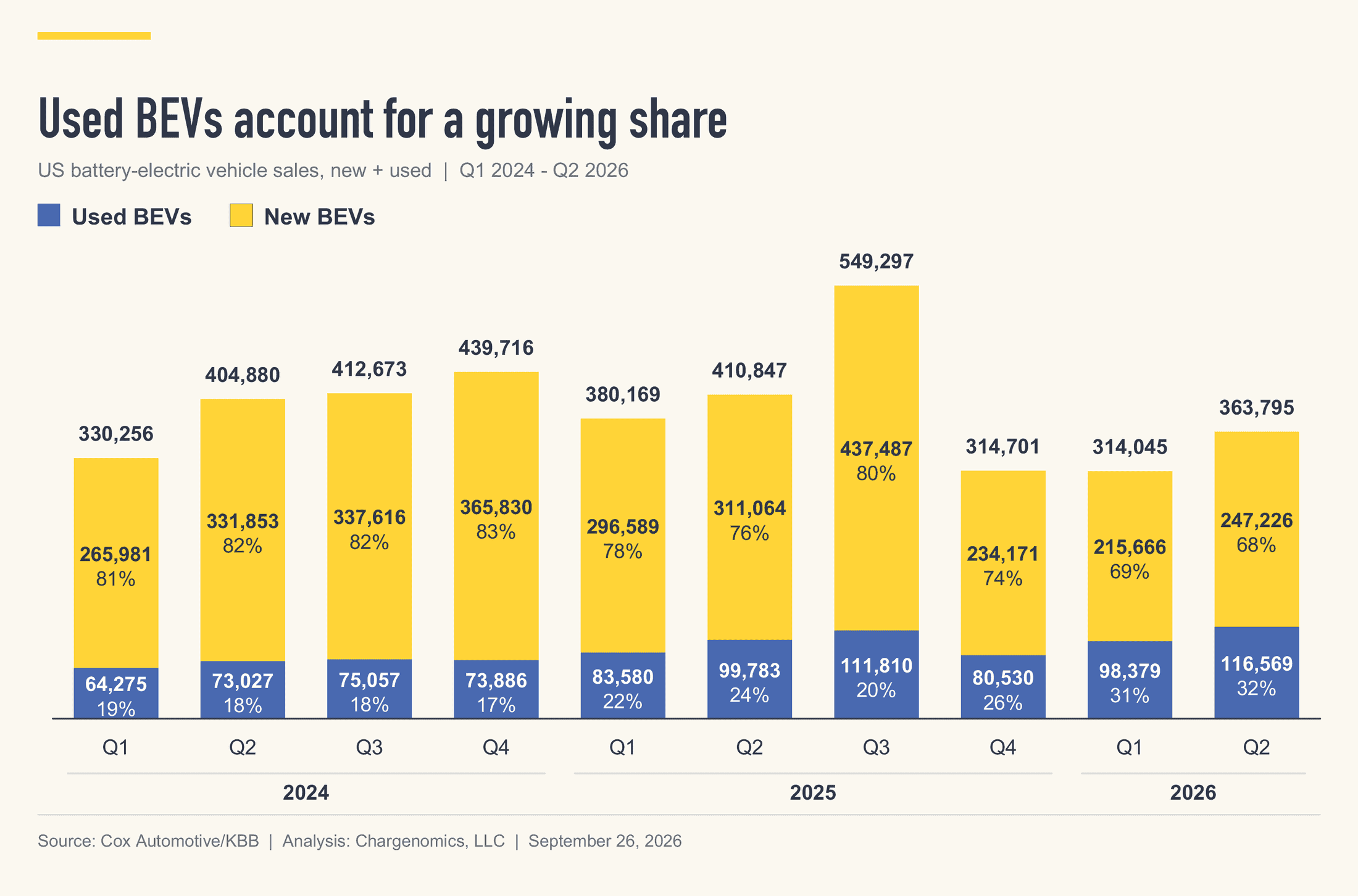
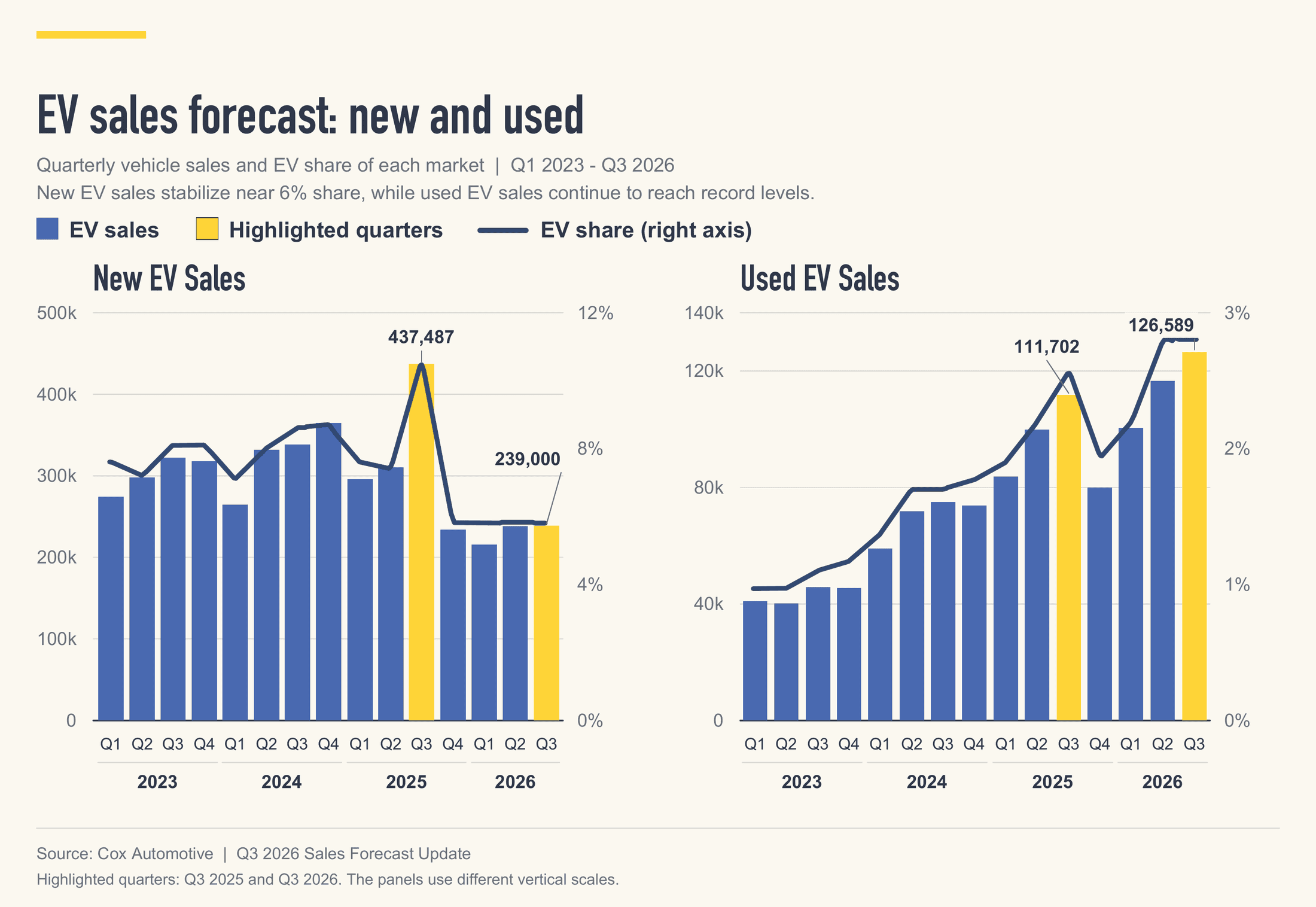
But EVs add a new wrinkle to the new-vs-used discussion. New EV sales have leveled out from the lows they hit after incentives ended a year ago—but used EV sales have grown for four quarters as a proportion of all EVs sold in the US.
CEO and Chief Analyst Loren McDonald of Chargenomics quantified the evolution. In the first quarter of 2024, 330,000 EVs were sold. Just 19 percent of those were used. The peak EV sales quarter, Q3 of 2025, when incentives were about to expire, saw a whopping 550,000 sold—20 percent of them used. But from April through June this year, a total of 364,000 EVs were sold—and the used proportion is now up to 32 percent.
Higher gas, more cars, lower prices
Two things came together to boost interest in (and lately the prices of) used EVs. First, more than 600,000 new EVs were leased from 2023 to 2025 to take advantage of the commercial-purchase loophole in the IRA. Their three-year leases are now starting to expire, dumping them back into the resale market. Most have fewer than 30,000 miles; some are below 20,000.
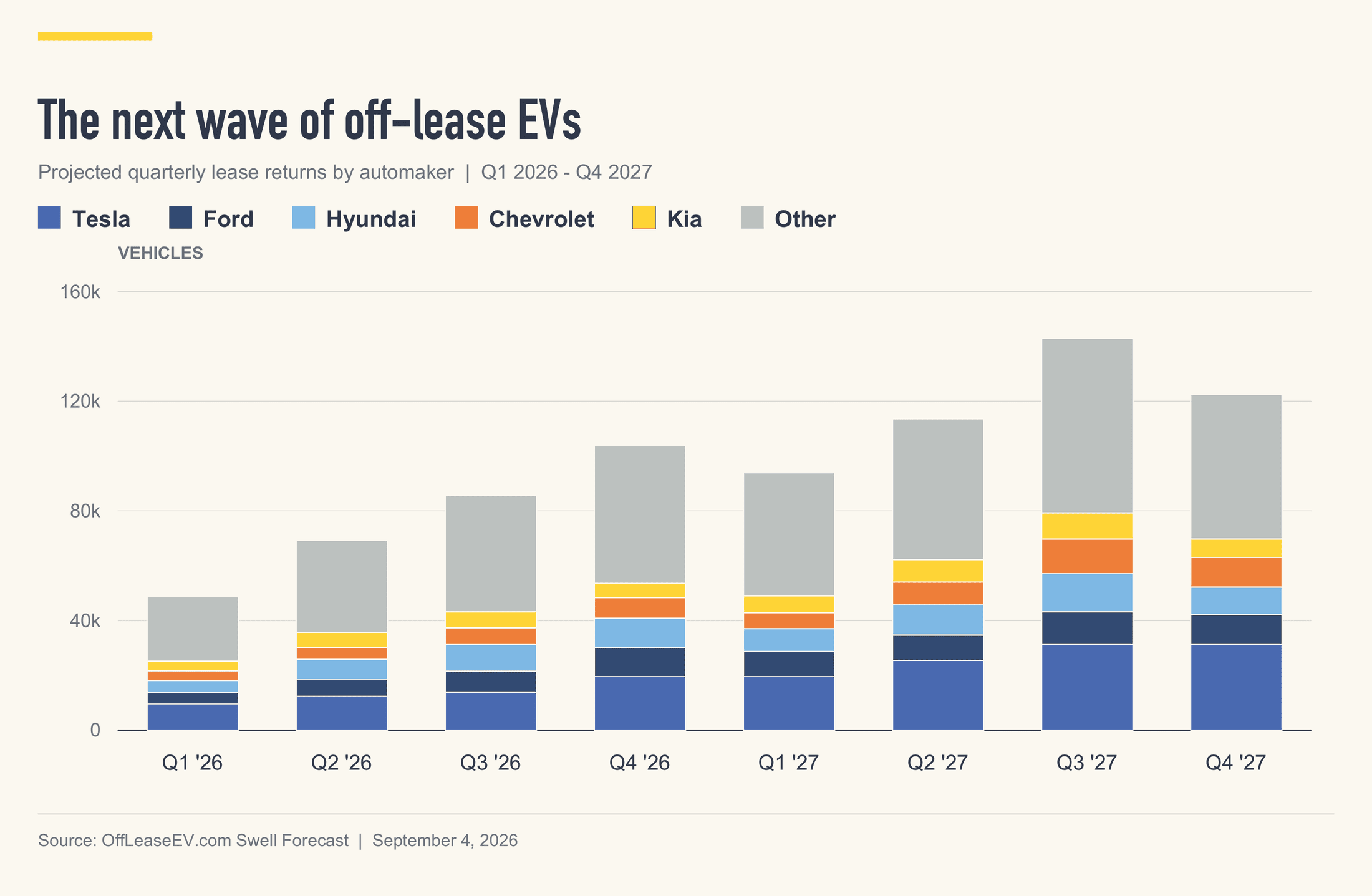
OffLeaseEV.com, a data website run by EV industry insiders, includes data on the number of vehicles entering the market. The number of lease-return EVs doubled from Q1 to Q4 of this year—more than 100,000 fresh off-lease electric cars are expected to hit the market this October through December. A further swell in EV lease returns will come in the third quarter of next year, 2027: nearly 150,000. An even greater swell will hit in 2028, as the last wave of leases from the second and third quarters of 2025 arrives.
Second, the most anti-EV US administration in history launched a war of choice, still ongoing, that has boosted fuel prices 40 percent or more in a matter of months. Drivers feeling the pain in their wallets when filling up likely have at least one friend, neighbor, coworker or relative who points out that it cost them the same amount to “refuel” when plugging in this month as it did in January.
The same depreciation that has been so painful for early EV owners can become a major advantage for the next buyer.
Fuel isn’t the only thing that costs more this year. The lack of affordable new vehicles has been an industry theme for a few years now, and the drumbeat has grown lately. It turns out that used EVs are a spectacular deal, because unfamiliarity among dealers and shoppers made them depreciate more—though that data is skewed because the reductions from government incentives aren’t reflected in the percentages. “The same depreciation that has been so painful for early EV owners can become a major advantage for the next buyer,” said Paul Waatti, Director of Industry Analysis at Autopacific.
People noticed, prices rose
Jimmy Douglas, founder and CEO of Plug, which supplies used EVs to dealers, offered more fine-grained detail in an interview with Charged. He pointed out that used EVs are increasingly being traded in and bought from franchised auto dealers rather than pure used-car outlets or EV specialists. By August, 59 percent of used EV sales went through new-car dealerships, up from 55 percent the month before.
Perhaps most interesting, while active listings for used EVs are steadily increasing (44,000 in August vs 37,000 in July), those EVs sold as fast in August as they did in February—42 days on average, per Cox Automotive—despite a far greater volume of EVs sold (30,879 in February, 44,350 in August, a 44 percent jump).
Perhaps most interesting, while active listings for used EVs are steadily increasing, those EVs sold as fast in August as they did in February—42 days on average, per Cox Automotive—despite a far greater volume of EVs sold, up 44 percent.
Douglas noted some standouts, including the Ford Mustang Mach-E (an average of 20 days to sell) and the now discontinued Ford F-150 Lightning (18 days). The bulk of used EV listings, he acknowledged, remained firmly in the Tesla category. The sheer sales numbers of the Model 3 (since 2017) and the Model Y (since 2020) ensure that they’re the used-car volume leaders by far.
Among other used EV models, Cadillacs do well, he said, as they’re bought by higher-end shoppers who want the premium EVs and are less focused on cost. Volkswagen ID.4s “sell like crazy,” in part because after six model years, earlier versions are inexpensive now. The Hyundai Ioniq 5 and Kia EV6 are at 21 and 18 days respectively. In fact, his data shows the top 8 used EV models by volume all sell faster now than they did before the Iran War began.
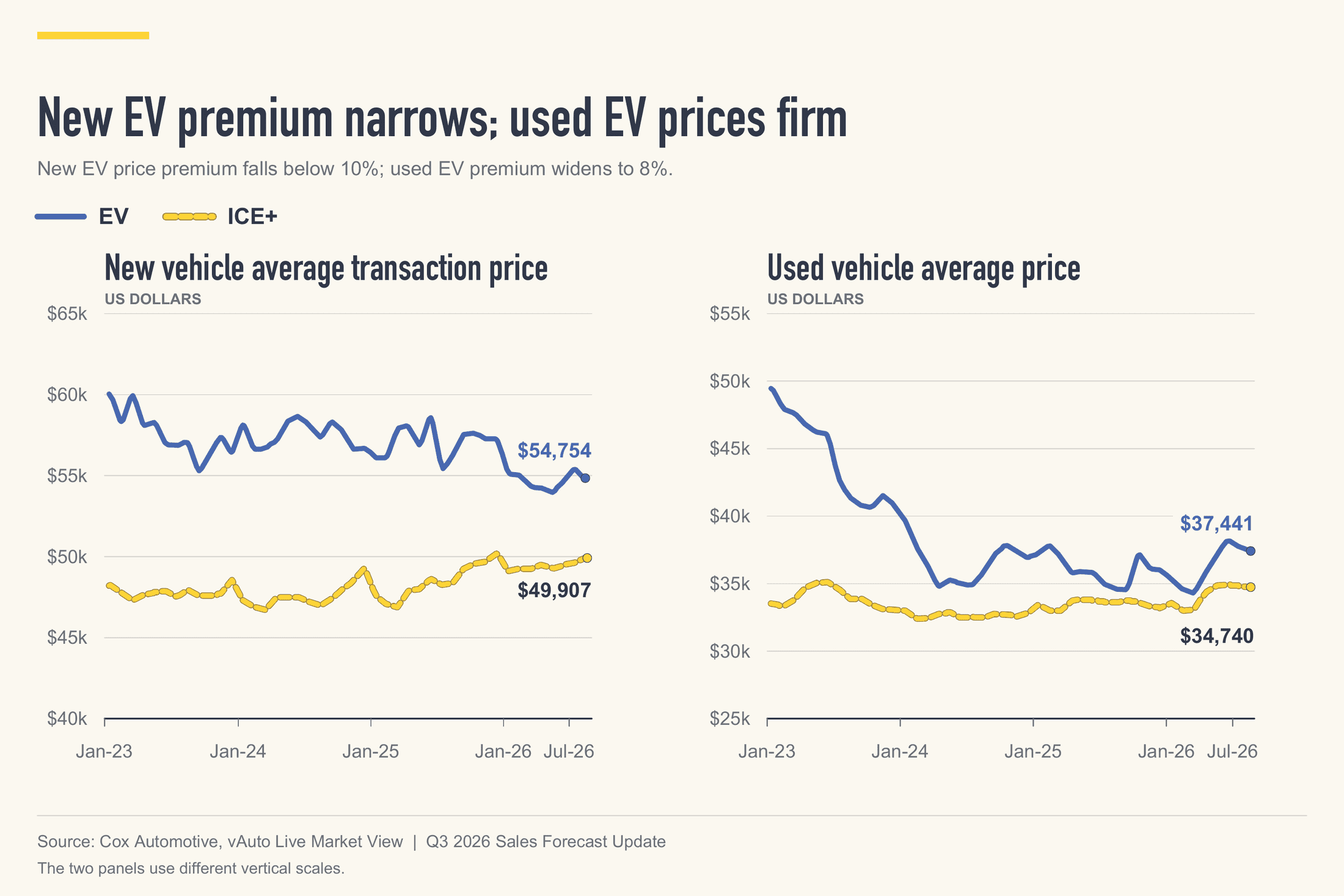
This demand spike has led, Douglas said, to a rise in used EV prices. Data from Cox Automotive shows that, while new EVs still cost roughly $5,000 more than the average price for all vehicles, average used EV prices—which had been trending toward parity—jumped 7.5 percent from February ($34,821) to August ($37,441).
Stephanie Valdez Streaty, Director of Industry Insights at Cox Automotive, discussed the phenomenon in the company’s Q3 2026 Sales Forecast Update Presentation. “Used EV sales continue to grow both sequentially and year over year,” she said.
More detail: “Used EV listing prices [were] up 8.2 percent year over year” compared to a roughly 3-percent rise for ICE vehicles. “That widened the used EV premium from 2.9 percent a year ago to 7.8 percent today. More off-lease EVs are entering the market, expanding the number of used EVs available to consumers, even as pricing remains firm.”
Battery health: no standard measure
Used EV listing prices were up 8.2 percent year over year compared to a roughly 3-percent rise for ICE vehicles.
Still, a major sticking point to buying a used EV remains the concern over battery life. While EV batteries are warranted against outright failure for at least 8 years or 100,000 miles in the US—and some makers warrant that energy capacity will remain at 70 percent or better within a given time or mileage—there’s no universal or standardized measure of battery health.
“Companies like Recurrent now track hundreds of thousands of cars,” said Sam Abuelsamid, VP of Market Research at Telemetry, “and their data shows that even at 100,000 miles, most EVs—except for older, air-cooled Nissan Leafs—still have at least 90 percent of their original battery capacity.”
“With 100,000-mile warranties on batteries,” he added, “buyers should have no concern about that aspect.”
While largely supporting that argument, other analysts added details that could suggest slightly more caution. Robby DeGraff, Manager of Product and Consumer Insights at Autopacific, notes that today, a battery’s state-of-health information isn’t easily available, and often requires plugging into the vehicle’s OBD-II port and downloading specialized software to analyze and interpret the signals.
How the vehicle was charged affects that health: vehicles recharged almost entirely via DC fast charging—those used for ridesharing or driven by owners with no access to overnight home charging—may be more at risk of battery degradation than those charged exclusively at Level 2 stations.
When Congress voted in May 2025 to kill California’s Advanced Clean Cars II program, a requirement in that act that would have helped future used EV buyers died with it. Starting with 2027 models, every EV would have had to display its battery state of health as a simple percentage figure. Every EV also would have had to warrant at least 70 percent remaining capacity after 8 years or 100,000 miles. Neither of those is required of any EV sold in the US today.
“Ultimately, a battery-health score may need to become as fundamental to the used EV transaction as the odometer and vehicle-history report are today,” adds DeGraff’s colleague Waatti.
Cheap new EVs vs cheap used EVs?
Ultimately, a battery-health score may need to become as fundamental to the used EV transaction as the odometer and vehicle-history report are today.
The present flood of off-lease EVs will continue through the first three quarters of 2028, reflecting the period when the EV leasing credit remained in place. So, you’ll likely hear more and more about used EVs, from buying guides to industry analyses.
Even as more affordable new EVs enter the market next year and beyond—think the 2028 Ford Fathom, the 2027 Kia EV3 or the current Chevrolet Bolt—they will face strong competition from heavily depreciated EVs just three to five years old. “Two- and three-year-old EVs are basically like new,” Chargenomics’ McDonald said, “but often carry a discount of $10,000 to $20,000 versus a current year of the same model.”
So, he suggested, “Automakers and dealers not only have to worry about compelling new and affordable EVs from competitors—in many cases their prime competition might be their own EVs coming off leases.” That could hit not just their current lineup but their less expensive entries to come. While some shoppers will only settle for a new vehicle, others may struggle to decide whether a brand-new Ford Fathom really represents a better value than a three-year-old, well-optioned Ford Mustang Mach-E if each stickers at $30,000 to $35,000.
Bright future for used EVs
In July, California Governor Gavin Newsom signed legislation (SB168) that launches a new incentive program for new and used EVs bought by first-time buyers. Used EVs will be eligible for an incentive of $1,750, compared to the $4,000 used EV federal purchase incentive that ended last September 30. For used EVs, there is no income cap for buyers, but eligible used vehicles’ sticker prices are capped at $25,000—except for vehicles made by companies headquartered in California. Among volume EV makers, that is largely restricted to Tesla, Rivian and Lucid.
California leads every other US state in its percentage of new EVs sold—roughly one in four new vehicles sold in the state has a plug. EVs are far more of a known quantity there, the state has mature public charging infrastructure, and it has not let up on its goal of reducing vehicular emissions—one it has pursued since the early 1960s.
In the end, Abuelsamid said, “While used EV prices have crept up since February, they are still a fantastic value compared to new or even used gas vehicles.” He added that he bought a used 2023 model last year. “It’s been great, and my wife never wants to go back to a gas car.”
It’s possible that sentiment may become a refrain among US households previously priced out of new EVs—or unwilling to drop new-car money on such a new technology. Those gas prices don’t look like they’re coming down any time soon—and more EVs come off lease every month.
This article appeared in Issue 77: July-September 2026 – Subscribe now.
ZEV is a nonprofit all-EV carshare cooperative that offers service in the Puget Sound, Seattle, Spokane and Port Townsend areas of Washington State. The company’s mission is “to make EV ownership and access a real possibility for underserved communities.”
The company recently launched its new mobile app, aiming to make signing up, booking and accessing its shared EVs easier. ZEV says its new app offers faster onboarding, a more intuitive interface, expanded booking options, and a more efficient connection between the app and ZEV’s vehicles.
To celebrate the launch, ZEV is offering a low promotional rate for a limited time.
ZEV currently provides sedans (Chevy Bolt), pickup trucks (Rivian R1T) and passenger vans (Ford e-Transit).
“Making clean transportation accessible means making every step easier, from joining ZEV to booking a vehicle and getting on the road,” said Ry Armstrong, Executive Director of ZEV. “Our investment in the new ZEV app reflects our commitment to building a service around the needs of our members. By improving the everyday carsharing experience, we’re strengthening our ability to bring affordable, sustainable mobility to more communities.”
Swedish transport company Einride was an early pioneer in the development of autonomous electric trucks—the company has a cabless autonomous truck that has been running in pilots for several years. However, the company hasn’t put all its electric eggs in the autonomous basket—it operates a large heavy-duty EV charging site in California, and in August it placed an order for 500 Tesla Semis.
Now autonomous trucking is starting to happen. Einride has two of its cabless, driverless electric trucks running scheduled routes with EASE Logistics in Marysville, Ohio. The operations are part of the Truck Automation Corridor Project, a joint effort of the Ohio Department of Transportation (ODOT), DriveOhio, and the Indiana Department of Transportation. This is EASE’s third autonomous trucking deployment with DriveOhio.
“EASE believes in leading through action and putting innovation to work in real-world operations,” said Peter Coratola Jr, President and CEO of EASE Logistics. “This deployment builds on that commitment while helping advance the adoption of autonomous freight across the transportation industry.”
Einride’s vehicles are capable of SAE Level 4-autonomous mode, meaning that they operate without a human in the cab—a remote operator monitors each truck off-site and can intervene if needed. The trucks run on local public roads, carrying freight between EASE facilities. The deployment is generating operational data on safety, reliability and efficiency that will inform how autonomous freight scales beyond this initial route.
“This deployment reflects the maturity of our purpose-built autonomous stack, combining driverless operation with remote oversight to run safely in real-world operations,” said Henrik Green, CTO at Einride. “Daily operations in Marysville give us the proof points we need to keep expanding autonomous freight across the corridor and beyond.”
Researchers at Chalmers University of Technology in Sweden have assessed how much reconfigurable battery packs could extend EV battery life and reduce lifetime cost. The study, published in Nature Communications, was carried out with PHINIA and Scania.
Battery packs in EVs consist of many interconnected cells that do not age in the same way. In a conventional pack, the weakest cell can therefore set the limit for the entire pack.
Albert Škegro, a doctoral student at Chalmers and the study’s first author, explains the problem by picturing the cells connected by a rope while they all try to move forward. “Since they are bound to each other, everyone has to keep the same pace as the slowest cell and stop when that cell stops,” said Škegro. “With the solution in our study, the battery can instead bypass the cell that is causing problems and continue forward.”
In a reconfigurable pack, switches and control systems can change the connections between the cells. The researchers say that in their models, controlling each cell separately could extend battery life by over 20% in some high-voltage vehicles, such as electric trucks and long-range cars. In practice, groups of cells are more likely to be controlled together, so that figure is a theoretical upper limit.
In one example, the researchers modeled a typical 80 kWh battery in a car driven 12,000 km per year and assumed a conventional pack would be replaced after 10 years. In the model, the reconfigurable pack reached that replacement point after about 11 years, roughly 14 months later. It also had a higher residual value because it had degraded less.
The technology is not yet available in series-produced vehicles but has been tested in research and industrial prototypes. Reconfigurable packs require additional electronics, which raise their upfront cost.
“The results show that the architecture can already be cost-effective under a wide range of real-world usage conditions,” said Changfu Zou, Professor at the Department of Electrical Engineering at Chalmers. “Based on a component-level analysis using automotive-grade hardware, the additional hardware would increase the total pack cost by approximately nine percent.”
The front lines of electrification have spread to some seemingly-unlikely parts of the world, for various reasons. In Russia, the country’s war on Ukraine has resulted in major disruptions to the supply of refined oil products, boosting the demand for EVs. And, as elsewhere in the world, it’s mostly Chinese automakers that are meeting that demand.
The New York Times reports that the number of electrified vehicles (including hybrids), sold in Russia grew from 43,000 in the January-to-August period of 2025 to more than 83,000 over the same period this year, according to the Russian Ministry of Industry and Trade.
Tthe share of plug-in vehicles (EVs and PHEVs) recently reached 11.5 percent of the Russian car market, up from about 5 percent at the beginning of the year, according to auto research agency Avtostat. The EV market share in Russia is now slightly higher than in the US—but a mere fraction of China’s 45 percent.
Russian auto industry expert Sergei Tselikov told the Times that in July, as Ukrainian drone strikes against oil refineries left drivers across the country waiting for hours at gas stations, he bought a Chinese electric hatchback.
“I tried to fill up one of my cars and drove around to five nearby gas stations, but they had only diesel or lower-grade petrol,” he said.
To try to address the shortages, the government is allowing the sale of lower-grade gasoline and diesel—which are not healthy nourishment for cars. The manager of a Moscow repair shop told the Times that he had recently serviced 15 vehicles with clogged diesel soot filters, a problem caused by the cheap fuel.
Mr, Tselikov is not the only one who has seen the electric light. As the fuel crisis continues, EVs are selling out at dealerships, and online listings for used EVs are scarce.
At a huge dealership complex near Moscow, a manager at Evolute, a brand of Russian-assembled electric vehicles based on Chinese designs, said there was no inventory left on his lot. The complex houses more than 40 dealerships, most of which used to sell brands from the West, Japan and South Korea. When the Times visited, they counted 25 Chinese showrooms.
Lines are starting to appear at public charging stations—but shorter ones than seen at gas stations.
The Russian government has been interested in promoting EVs for over a decade, but actual adoption has been slow until now. EVs are generally exempted from transport tax and in Moscow and other big cities, from parking fees. Russian-made EVs are eligible for government subsidies.