The global electric vehicle industry is experiencing rapid growth, driving an urgent demand for power conversion systems that are not only efficient but also highly reliable. Among these, the on-board charger (OBC) is a critical component, tasked with converting alternating current (AC) from various charging infrastructures, residential, commercial, or public, into direct current (DC) suitable for charging high-voltage battery systems.
The performance and safety of the OBC directly impact overall vehicle efficiency, battery health, and user experience. As the EV ecosystem evolves to incorporate advanced functionalities such as vehicle-to-grid (V2G), vehicle-to-home (V2H), and modular, distributed power electronics, the requirements for testing and validation have become more complex and rigorous, particularly under variable and dynamic electrical conditions.
This article presents a comprehensive overview of how Kikusui’s cutting-edge power testing solutions specifically, the PCR-WEA/WEA2 series of programmable AC/DC power supplies, the PXB series of bidirectional DC power supplies, and the PLZ-5WH2 high-speed DC electronic loads enable detailed evaluation, functional testing, and seamless system integration of OBCs and other critical EV power electronic components, including traction batteries. These tools support robust characterization across a range of real-world scenarios, contributing to improved design validation, compliance, and performance optimization in next-generation electric mobility systems.
Electric vehicle OBCs serve as the primary interface between the power grid and a vehicle’s high-voltage battery, enabling safe AC-to-DC conversion across a wide range of input conditions. Modern OBCs must not only provide efficient unidirectional charging but increasingly support bidirectional energy flow for V2H/V2G functions, grid-interactive services, and energy storage applications.
At the same time, automotive manufacturers are shifting toward compact, modular, and multifunctional power electronic assemblies, combining OBCs, DC/DC converters, and junction boxes into integrated units to reduce size, weight, and cost.
These advancements increase the need for:
- Robust AC-side resilience against voltage sags, frequency variations, momentary interruptions, and harmonic distortion.
- Stable DC-side control, ensuring proper charging behavior, battery protection, and compliance with global standards.
- Test equipment capable of reproducing worldwide grid conditions, enabling repeatable and accelerated development.
Kikusui’s laboratory-grade power systems provide this controlled environment, ensuring OBCs and battery systems are verified under real-world electrical variability with high fidelity.
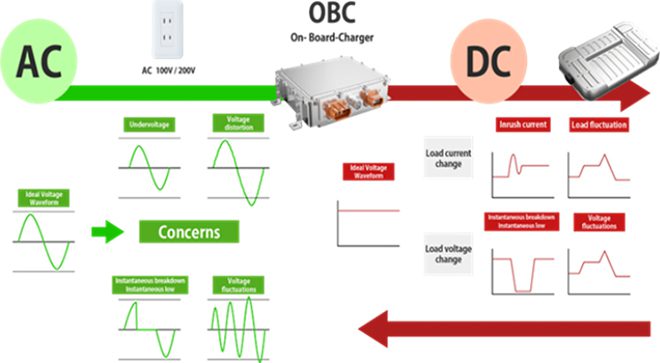
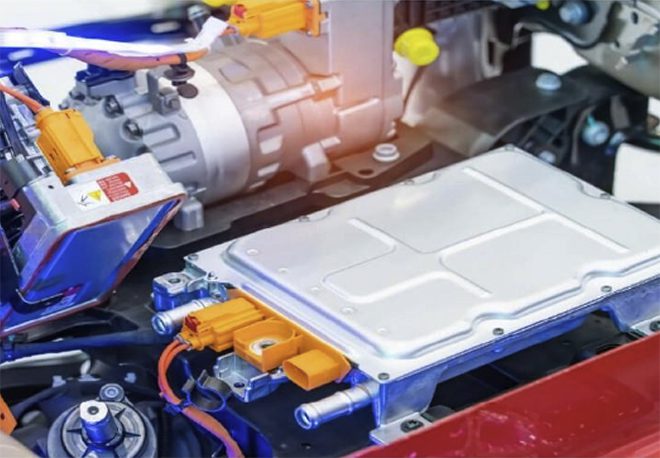
Figure 1. AC–DC Conversion of Voltage and Current Waveforms in an On-Board Charger (OBC).
AC-Side Evaluation of On-Board Chargers
The PCR-WEA/WEA2 Series is a high-capacity AC/DC regulated power supply designed for flexible, high-precision grid simulation. It supports all major global AC configurations used for electric vehicle (EV) charging, including:
- Single-phase 120 V (commonly used in USA)
- Single-phase 200 V three-wire (L1-N-L2, typically 100 V line-to-neutral, 200 V line-to-line)
- Three-phase 208V (line-to-line), common in industrial or commercial charging applications
A single PCR-WEA/WEA2 unit can replicate these voltage and phase conditions without requiring additional hardware, significantly reducing test complexity and enabling rapid configuration changes for global compliance testing.
The 15-model PCR-WEA2 lineup offers AC/DC output from 1 kVA to 36 kVA, with variable single- and three-phase output from 6 kVA upward. It features a regenerative mode for reduced power consumption and supports mix-and-match parallel operation up to 144 kVA for scalable test systems, the series offers:
- Output frequency flexibility up to 5 kHz
- 4x rated peak current capability
- 1.4x inrush current tolerance for 500 ms
These features enable engineers to accurately evaluate OBC performance during startup, simulate real-world grid disturbances, and validate transient handling during rapid load transitions.
Available power configurations options 1 kVA and 2 kVA, 4 kVA, 8 kVA, 12 kVA, 16 kVA, 20 kVA, and 24 kVA. For applications requiring higher capacity, parallel operation can extend the output up to 96 kVA. Additionally, the three-phase PCR-WEA2 series is available in 3 kVA, 6 kVA, 12 kVA, 18 kVA, 24 kVA, 30 kVA, and 36 kVA models, with parallel expansion possible up to 144 kVA.
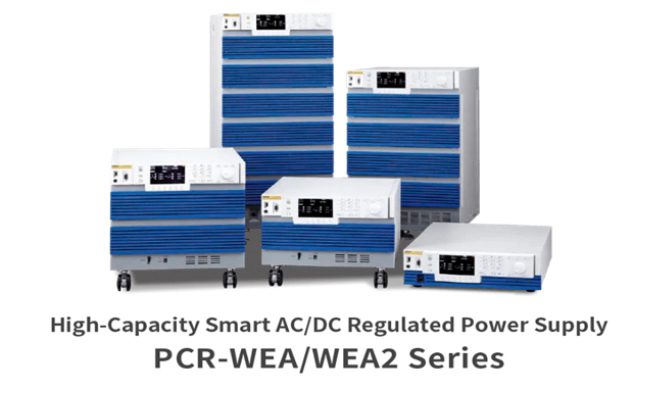
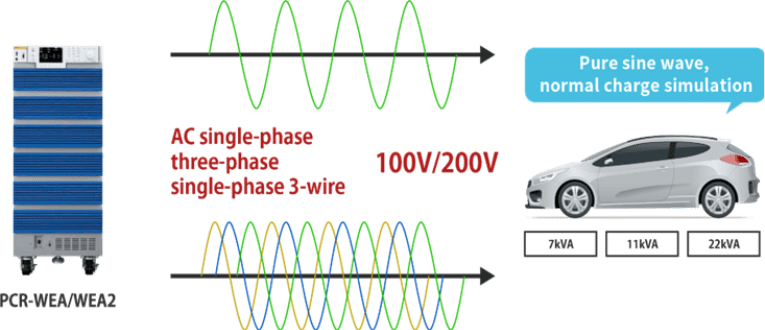
Figure 2. AC Power Simulation for EV Charging: Single-Phase and Three-Phase 100V/200V Inputs Delivering Pure Sine Wave Outputs for 7kW, 11kW, and 22kW Charging.
Key Features and Benefits of PCR-WEA/WEA2:
- Versatile Output Configurations supporting all major EV charging voltages.
- Ultra-Compact Design providing high power density for reduced lab footprint.
- Exceptional Transient Handling for inrush and peak-load events.
- Advanced Sequencing Functions to simulate disturbances, harmonics, and advanced grid behavior.
- Global Grid Simulation with adjustable voltage, frequency, and phase.
- Proven Reliability, widely used in Japanese automotive and consumer electronics industries.
Sequence Functions for Advanced AC Simulation
The PCR-WEA/WEA2 Series incorporates sophisticated waveform programming that allows engineers to replicate complex utility grid behavior with precision. These functions are essential for evaluating OBC reliability, EMC performance, and compliance with international test standards.
Simulation of Power Disturbances
The system can reproduce a range of real-world anomalies, including:
- Undervoltage/Overvoltage
- Voltage dips, swells, and fluctuations
- Instantaneous interruptions
- Waveform distortion
These simulations help verify OBC operation during brownouts, unstable infrastructure, and transient grid events.
Harmonic and Phase Control
The PCR-WEA/WEA2 supports harmonic synthesis up to the 40th order, enabling detailed analysis of power factor correction (PFC) behavior and OBC EMI performance. Adjustable initial phase settings (e.g., 0°, 90°, 270°) enable worst-case startup scenario testing.
Compliance and Standards Testing
The series supports testing aligned with major global power quality standards, such as:
- IEC 61000-4-11 – Voltage dips, short interruptions, variations
- IEC 61000-4-28 – Frequency variations
- IEC 61000-4-34 – Voltage disturbances for high-current equipment
These features help manufacturers validate devices before formal certification, reducing development cycles and compliance risk.
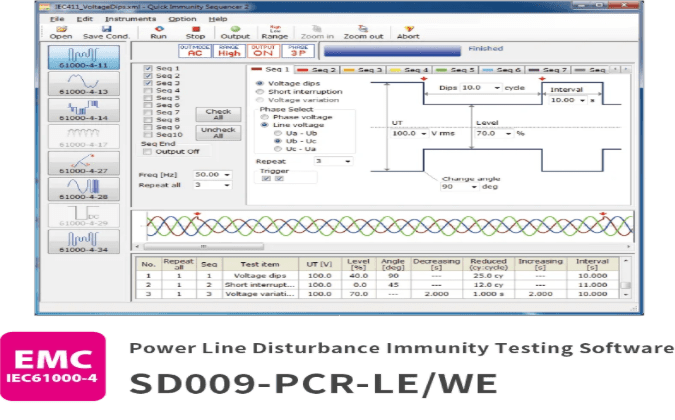
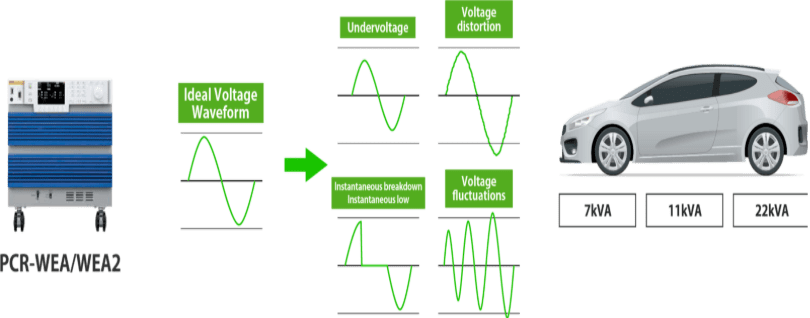
Figure 3. Various Sequence Functions: Simulation of Voltage Dips, Interruptions, and Harmonic Waveforms for Compliance with IEC 61000 Standards
DC-Side Evaluation of On-Board Chargers
To complement AC-side testing, Kikusui provides powerful DC-side test instruments, including the PXB Series bidirectional DC power supply and the PLZ-5WH2 Series high-speed DC electronic load.
PXB Series – Bidirectional High-Capacity DC Power Supply
The PXB Series offers bidirectional operation, allowing both sourcing and sinking of power for energy-regenerative testing. This reduces total energy consumption during extended test cycles.
Supporting voltages up to 1,500 V, the PXB series is ideal for evaluating high-voltage battery systems (300–750 VDC typical). Its regenerative capability simulates both charging and discharging conditions, closely reflecting actual EV operating environments.
PLZ-5WH2 Series – DC Electronic Load
The PLZ-5WH2 Series provides high-speed transient response and precise dynamic load control, enabling accurate measurement of OBC output characteristics such as voltage regulation, ripple, and transient response.
With voltage handling up to 1,000 V, it allows engineers to evaluate the OBC’s behavior under sudden load changes, ensuring safety and reliability in real-world operation.
System Integration and Application Flexibility
By combining the PCR-WEA/WEA2, PXB, and PLZ-5WH2 systems, Kikusui delivers a fully integrated OBC test environment capable of simulating both grid-side and battery-side conditions with precision.
This integrated platform allows:
- End-to-End AC–DC performance testing under variable grid conditions
- Long-term endurance and efficiency testing through regenerative power flow
- Harmonic, transient, and compliance testing per global standards
- Optimized energy use through power regeneration
Such a setup ensures comprehensive validation and accelerated development of next-generation OBC and EV power systems.
Conclusion
As EV power electronics expand in capability and complexity, the need for high-precision, globally representative test environments continues to grow. Kikusui’s PCR-WEA/WEA2, PXB, and PLZ-5WH2 series provide a comprehensive solution for AC and DC evaluation of OBCs, high-voltage battery systems, and related power electronics.
By delivering advanced harmonic simulation, regenerative operation, fast transient control, and compliance-oriented sequence functions, these instruments enable engineers to design, validate, and integrate next-generation EV charging and energy-management systems with confidence.
To learn more, please visit:
from Charged EVs https://ift.tt/FN6Qrvs


No comments:
Post a Comment