Wednesday, October 23, 2024

NuVant Systems launches diagnostic EV battery tool


Battery technology provider A3 Global’s NuVant Systems subsidiary has introduced its new LVc-40 tool for diagnosing, repairing, balancing and reconditioning hybrid and EV batteries.

The LVc-40 features 40 individual channels and includes an integrated computer, enabling it to run NuVant’s Pack-Builder software and leverage AI-driven algorithms to maximize battery performance. The system provides key diagnostic metrics such as internal resistance, watt-hour capacity, amp-hour capacity and individual cell voltages. It services popular battery modules and cells, including 18650s and 4680s used in Tesla vehicles and other leading models.

The LVc-40 is available for pre-order and is expected to ship in early 2025.

“The science behind the LVc-40 allows for pinpoint accuracy in identifying faulty cells and reconditioning batteries, which not only extends battery life but also boosts overall performance,” said Eugene Smotkin, Senior Vice President of Research and Development at NuVant Systems.

Source: A3 Global


from Charged EVs https://ift.tt/9KPQtgu

Advancing EV charging infrastructure with scalable power distribution: Whitepaper


The global transition to electric vehicles, both for individual and fleet use, has accelerated in recent years, and as the number of EVs on the road continues to rise, EV charging station providers often struggle to keep up. Providers face several challenges, including limitations of existing power infrastructure and high upfront costs of installation, as they race to meet growing demand.

This whitepaper examines these challenges and evaluates various EV charging power distribution solutions, with a focus on the advantages of ingress-protected track busways in providing flexibility and scalability.


from Charged EVs https://ift.tt/kryixhR

Tuesday, October 22, 2024

Volt Carbon Technologies develops lithium battery functional to -80° C


Canadian battery raw material and technology developer Volt Carbon Technologies has designed a high-entropy electrolyte to improve battery performance at low temperatures, which has demonstrated functionality at temperatures as low as -80° C in testing.

Solid UltraBattery, a Volt subsidiary, in collaboration with Volt Board Member, Dr. Aiping Yu, Professor and Director of the Carbon Nanomaterials Laboratory for Renewable Energy and Multi-functional Composites at the University of Waterloo produced a proof of concept for the electrolyte. In tests conducted using lithium coin cells, the new electrolyte demonstrated higher performance than conventional electrolytes, according to the company.

The results showed that, at -40° C, the electrolyte retained 62.5% of its capacity, compared to just 16.8% for the standard electrolyte. At -60° C, the electrolyte maintained 49.7% capacity, while the standard electrolyte showed no capacity retention. At -80° C, the electrolyte retained 30.3% capacity, a result that the company considers to be a significant advancement in battery technology for cold environments.

Volt Carbon is developing pouch cells to validate the electrolyte’s performance at a commercial scale.

“The ability of our proprietary electrolyte to perform at temperatures as low as -80° C highlights its potential for industries demanding reliable energy storage in extreme conditions, such as automotive, aerospace and defense. This innovation is particularly critical for regions like Canada, where winter temperatures can severely affect battery performance,” Dr. Hey Woong Park, Head of Battery Development at Solid UltraBattery, said. “Last winter’s extreme freeze, which left many electric vehicles stranded due to charging inefficiencies, illustrates the urgent need for advancements like ours. With this technology, we aim to overcome the challenges of cold-weather battery performance, ensuring reliable operation even in the most demanding climates.”

Source: Volt Carbon Technologies


from Charged EVs https://ift.tt/DStz7en

Altilium to produce EV battery cells using recovered materials


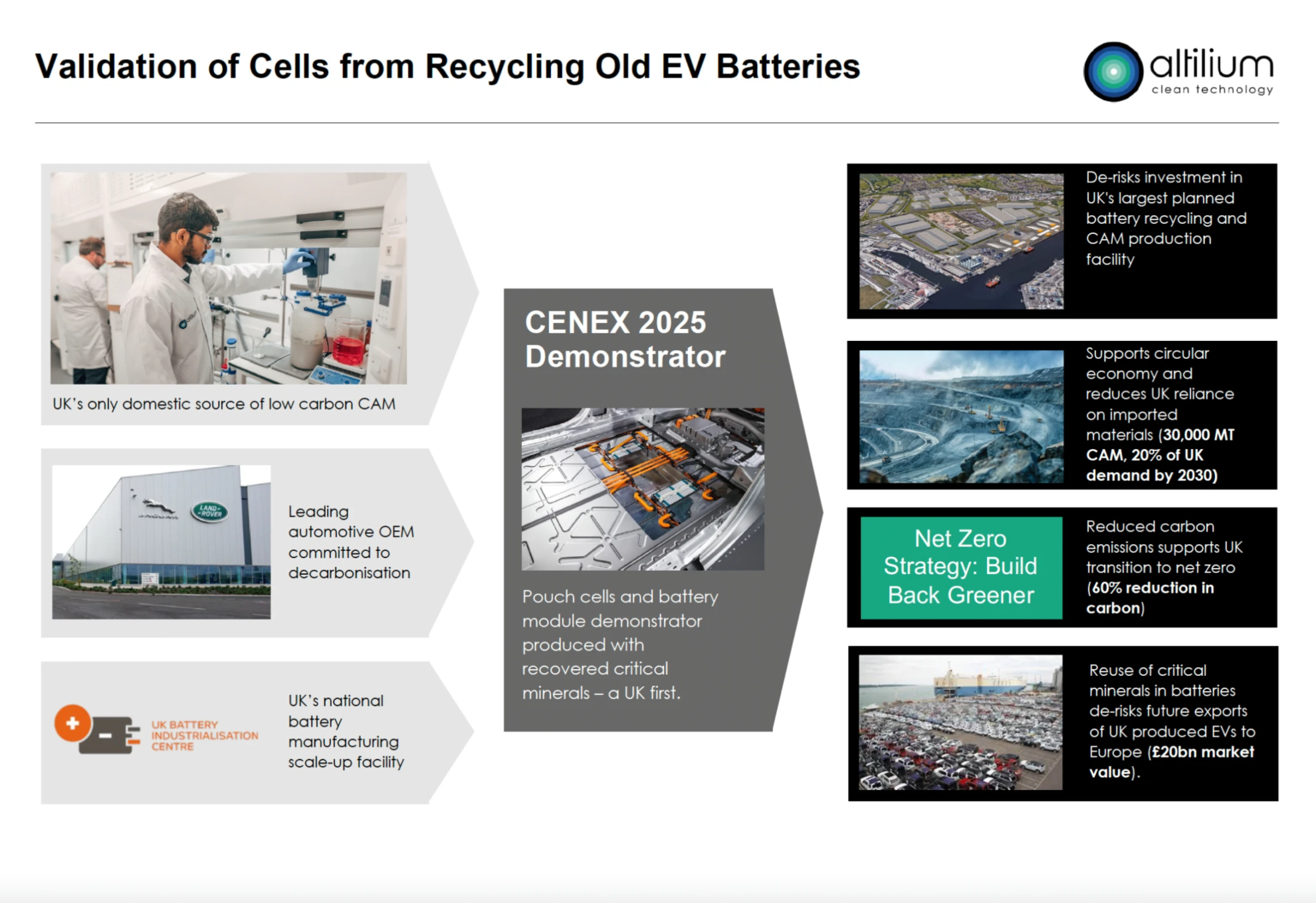
UK-based battery materials recycling company Altilium has announced a project to produce EV battery cells using cathode active materials recovered from end-of-life EV batteries and validate them for use in vehicles for UK-based luxury car manufacturer JLR. 

The project is supported by the Advanced Propulsion Centre UK under the latest round of its Advanced Route to Market Demonstrator (ARMD) competition.

Altilium says its EcoCathode process, used to recover such materials as lithium, cobalt and nickel, results in a 60% reduction in carbon emissions by lessening the need for newly mined materials.

Battery production will take place at the UK’s national battery manufacturing scale-up facility, the UK Battery Industrialisation Centre (UKBIC), using recovered materials produced by Altilium in Devon at its mini-commercial ACT2 facility and its ACT1 pilot. JLR will conduct validation studies on the pouch cells at its battery testing facilities.

Altilium COO Christian Marston said, “By demonstrating that EV battery cells made from recovered materials can meet the rigorous standards of the automotive industry, we’re not only reducing the environmental impact of battery production but also supporting the UK’s efforts to build a more sustainable and resilient EV supply chain.”

Source: Altilium


from Charged EVs https://ift.tt/6imjkVs

Delaware, EPA announce $14.3-million electric vehicle charging initiative along I-95 


The state of Delaware has received $14.3 million in federal grants to install medium- and heavy-duty EV charging stations along the portion of Interstate 95 that is within its borders to improve air quality and expand alternative fuel infrastructure.

The creation of electric vehicle infrastructure along I-95 is part of an initiative organized by the Clean Corridor Coalition, a project to develop a regional approach to decreasing emissions from Maryland to Connecticut. 

State leaders recently gathered to celebrate the receipt of federal funding for the project at the Biden Welcome Center, which was named after then-Senator Joe Biden in 2018, along a stretch of highway named for another president, John F. Kennedy. 

“This grant is a huge step forward for Delaware. By adding charging stations along I-95, we’re helping reduce pollution and bettering the air quality, while also supporting the freight industry, two things we all rely on,” Majeski said. “We are excited to work with our neighboring states and look forward to seeing the benefits of this project.” 

The I-95 corridor, one of the most heavily-trafficked freight routes in the nation, connects nine states in the Mid-Atlantic and Northeastern United States. 

Source: Delaware Department of Transportation 


from Charged EVs https://ift.tt/1GOBLV8

Toyota, Lexus drivers in New York City to get free EV charging in deal with Revel Transit 


Toyota Motor and Revel, an operator of an EV taxi service and a network of high-speed charging stations, have signed an agreement that will give owners of Toyota and Lexus EVs complimentary access to Revel’s DC fast charging network in New York City. 

The agreement runs through October 14, 2027. 

Revel, which began life as the operator of a moped-sharing service using dockless EV mopeds in 2018, currently has four high-volume stations in the Big Apple, all of which offer both NACS and CCS plugs. 

“Working with Revel will help elevate the charging experience for our customers in the New York City area while underscoring Toyota’s commitment to supporting sustainable mobility solutions and enhancing the ownership experience,” said Christopher Yang, Group VP at Toyota EV Charging Solutions. 

Toyota Ventures, Toyota’s early-stage VC firm, first invested in Revel in 2019. The automaker said that supporting Revel’s network expansion in New York City and other markets will provide Toyota with “the ability to further research and evaluate charging program opportunities.” In addition, Toyota said that it hopes to “increase widespread adoption of electric vehicles through customer convenience.” 

Revel opened its first public fast charging station in Brooklyn with 25 chargers in 2021. 

The company’s four New York City locations are in the Bedford-Stuyvesant neighborhood of Brooklyn where it has 25 stalls, Long Island City in Queens with 14, South Williamsburg in Brooklyn with 15 and Lower Manhattan, near the South Street Seaport, with 10 stalls. Revel has previously announced plans to open four new charging stations in the city, namely at LaGuardia Airport in Queens with 48 stalls, Maspeth in Queens with 60 stalls, Red Hook in Brooklyn with 20 stalls and the South Bronx with 25 stalls. 

Revel also has plans to open California locations in Los Angeles, Oakland, San Francisco and San Jose.  

Source: Toyota Motor North America


from Charged EVs https://ift.tt/npSEqYl

Monday, October 21, 2024

Austrian Airlines deploys hydrogen-powered mobile generator for charging EVs


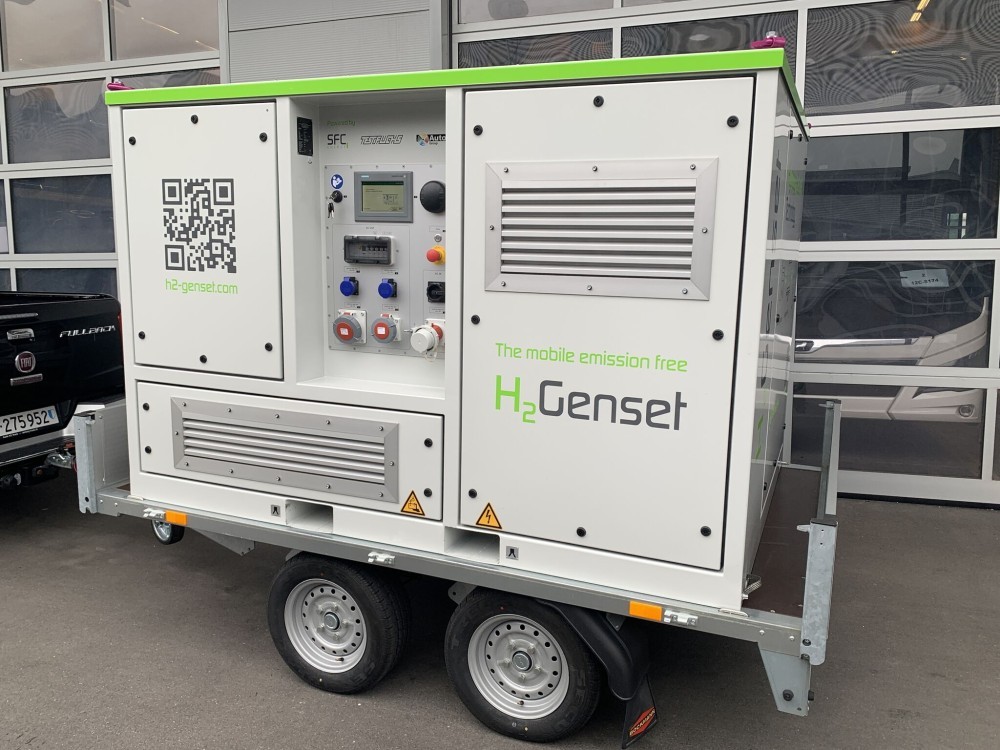
Three companies in Central Europe—Test-Fuchs, SFC Energy and Auto Group—have announced the release of the H2Genset, a hydrogen-powered mobile generator.

The trailer-mounted power generator can be used to charge electric vehicles in situations where it is preferable or necessary to bring the power source to the vehicles.  

Austrian Airlines has deployed the H2Genset on the airport apron in Vienna, where it can be used to support a mobile DC fast charger to charge the airport’s electric vehicles. The H2Genset has an output of both 230 V and 400 V AC. 

Hydrogen is an energy storage medium that is far less efficient than batteries, as an analysis by the Copenhagen Centre on Energy Efficiency explains (see also InsideEVs, The Guardian, Flux Power, et al). The vast majority of hydrogen produced today comes from fossil fuels. However, some users still choose to use hydrogen for applications in which speed of refueling and/or low weight is a top priority.

The H2Genset also has numerous other applications, including serving as a backup for an EV charging station, or an off-grid power supply at worksites to recharge electric vehicles and equipment.  

Austrian is also testing the application of hydrogen power in the air with the deployment of a power supply aboard an Airbus A320 that uses a frequency converter from Dynell, an Austrian aviation power equipment manufacturer. 

Meanwhile, the H2Genset was introduced and tested in April at the Donauinselfest in Vienna, where it powered four mobile transmitters needed to support the large number of music fans attending the festival and using their smartphones to share the event with others.

Source: Austrian Airlines 


from Charged EVs https://ift.tt/iv2wpdP

ConnectDER’s meter socket adapters simplify EV charging installations, now approved for installs in Washington DC

ConnectDER makes a line of meter socket adapters (MSAs), also known as meter collars, for solar, battery storage and EV charging installat...