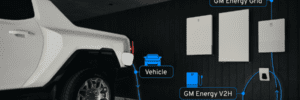
Bidirectional EV charging, which supports vehicle-to-home (V2H) and vehicle-to-grid (V2G) functions, is gradually moving from the pilot stage to commercial availability. EVs from automakers including Ford and Kia now offer bidirectional features.
GM’s Chevrolet Equinox EV, GMC Sierra EV and Cadillac Lyriq now offer bidirectional capability, and the automaker recently released a primer on how it works.
As GM explains, its vehicle-to-home (V2H) feature can turn a compatible GM EV into a source of backup power. In case of an electrical outage, the vehicle can send electricity to a properly equipped house to operate appliances and other electrical loads.
Enabling these nifty features isn’t as simple as plugging an EV into a wall socket.
Using V2H requires a compatible GM EV and the GM Energy V2H system, which includes the GM Energy PowerShift Charger and GM Energy V2H Enablement Kit, as well as a suitable grid interconnection. The system needs to be installed by a licensed electrician.
Vehicle-to-grid (V2G) technology connects an EV to the local electrical grid through participating utility programs, where available, allowing the vehicle to send energy back to the grid.
V2G can help EV owners reduce electricity costs by charging an EV’s battery from the grid during off-peak times (late at night), then releasing energy to the home during peak usage periods (evening get-home-from-work time), if the local utility offers time-of-use pricing. In some regions, participating utilities may compensate customers for supplying energy from their EVs to the grid during periods of high demand. As GM notes, such programs remain limited.
Source: GM
from Charged EVs https://ift.tt/WFNHat0




No comments:
Post a Comment